
Landlord Property and Rental Management: An Owner's Guide

Editorial Staff
Content published by Hemlane is created and reviewed by members of our editorial team, including experienced technical writers and real estate professionals.
Vacant units cost money. Late rent costs more. And the 2 AM water heater call doesn't wait for business hours.
Most owners don't need a lecture. They need three things. Where income leaks. Which rules apply in each state where they own. And which work they can hand off without losing control.
This guide covers landlord property and rental management from the owner's chair. It opens with a numbered playbook of income levers. Then it walks through the legal basics: rent increase notice, repairs, entry and fair housing. Each rule comes as a real state example, with a plain way to check your own.
You call the shots. We take the load.
How can landlords maximize rental income?
Work the levers you control. Price to the market, lease fast, screen every applicant the same way, renew good tenants, collect rent on time, keep up with maintenance and stop paying fees you don't owe. Each lever protects something different: vacancy, turnover, delinquency, repair cost or fee leakage. Run them in one place and they're easier to track.
# | Lever | What it protects | Where it runs |
|---|---|---|---|
1 | Price to the market | Vacancy | Listing setup, before you post |
2 | Lease faster | Vacancy | Listings, showings and applications |
3 | Screen every applicant the same way | Delinquency and turnover | Applications and screening reports |
4 | Renew good tenants | Turnover | Lease tracking and renewal dates |
5 | Collect rent on time | Delinquency | Online rent collection and follow-up |
6 | Keep up preventive maintenance | Repair cost | Maintenance calendar and repair log |
7 | Keep your fees | Fee leakage | Payments and accounting |
Vacancy first. Every empty week is rent you never get back. Our listings go to Apartments.com, Zillow and 7 more top websites. On Hemlane, tenants are placed faster than the market average in the states we track. That's 25 vs. 33 days in California, 29 vs. 35 in Kansas and 26 vs. 47 in Texas.
Screening and renewals. A fast placement only helps if the tenant pays. Our screening covers national credit, criminal, eviction and income reporting. Run every applicant through the same report. Then keep the good ones. A tenant who renews is a turnover you skip. Track lease end dates so renewals never sneak up on you.
Late rent. Stressed about tenants not paying on time? Act early. Eviction Shield uses delinquency management and pre-mediation. It resolves 98% of cases before they ever reach a courtroom.
Preventive maintenance. Small upkeep beats big repairs. A dirty filter can raise energy costs and wear out heating and cooling equipment early. Put filter changes on a schedule and log each one.
Fees. $0 ACH fees. 100% of late fees go to you. Repairs are invoiced with no markups. The number on the lease is the number that lands in your account. Full rental accounting, with bank sync, a cash flow report and an income statement, shows where every dollar went.
Want to see placement, 24/7 repair coordination and direct rent payment working together? See how Hemlane runs on one platform. We support over 20,000 rental properties in 4,418 cities across the United States. We save clients over $1.15 million per month compared to other solutions. Read more about us.
How much notice does a landlord need to give before raising rent?
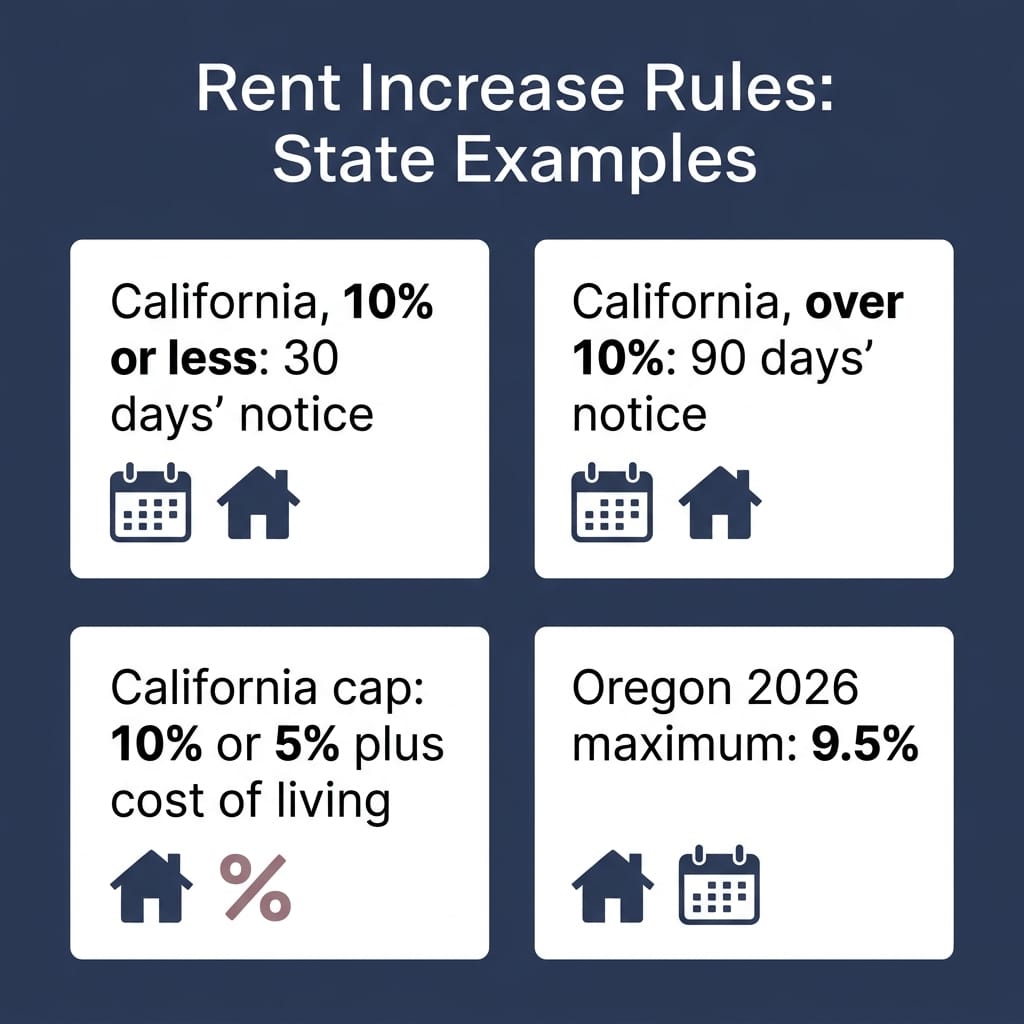
It depends on your state, and sometimes your city. There is no single national rule. In California, an increase of 10% or less needs 30 days' notice. An increase over 10% needs 90. Some states also cap how much rent can rise. Check both the notice rule and any cap for each property.
The California Attorney General lays out the notice periods by the size of the increase. California also has a cap. Under the Tenant Protection Act, most increases can't exceed 10% total or 5% plus the change in the cost of living, whichever is lower, over 12 months. The cap covers most increases, not all. Check whether yours is covered.
Caps differ by state and by year. Oregon's Department of Administrative Services set the maximum allowable increase for 2026 at 9.5%. That figure is for 2026 only.
State | Increase size | Notice before it takes effect | Cap |
|---|---|---|---|
California | 10% or less | 30 days | Most increases: 10% total or 5% plus cost of living, whichever is lower, over 12 months |
California | More than 10% | 90 days | The same cap applies to most increases |
Oregon | Any increase | Check Oregon's current rules | 9.5% maximum for 2026 |
Why it differs. Each state writes its own rental law. Some cities add their own rules on top. So one owner with doors in two states can face two sets of rules.
How to look up your own. Start with your state attorney general's tenant page or your state housing agency. Then check your city or county housing office. Read the statute itself where you can. Do this for each property's address.
Before you send a notice:
- Check your lease. See what it says about rent changes and when they can happen.
- Check the state and local rules for that address. Confirm the notice period and any cap.
- Send the notice in writing. It's good practice everywhere. Give the new amount and the date it takes effect.
- Keep a record. Save a copy, the date you sent it and how you delivered it.
Our Basic plan keeps lease tracking, document storage and tenant messaging in one place. The notice and the proof live together. Essential adds state-specific lease documents.
This is information, not legal advice. Confirm the rules for each property's state and city before you act.
What Repairs Are Landlords Responsible For?
You're responsible for keeping the rental livable under your state's habitability law, plus whatever your lease assigns to you. The exact list varies by state, and it changes. Sort every request by urgency. Respond the same way for every tenant. Keep a record. That protects the tenant, the property and you.
California shows how these duties grow. Under Assembly Bill 628, owners must provide a working stove and refrigerator in units under new, amended or renewed leases starting January 1, 2026. A checklist from a few years ago may already be out of date. Check your state's habitability law each year. Then read your lease. It should spell out who covers what.
Tier | Examples | What to do | What to record |
|---|---|---|---|
Emergency | Active water leak, no heat in cold weather, gas smell | Respond right away and get a pro on site | Time reported, who responded, what was done |
Urgent | No hot water, broken stove or fridge, a lock that won't close | Schedule fast and keep the tenant updated | Request date, updates sent, date fixed |
Routine | Dripping faucet, sticking door, worn fixture | Schedule within a normal window | Request, scheduled date, invoice |
Preventive | HVAC filters, seasonal checks, smoke alarm tests | Put it on a calendar | Date done, notes, next due date |
Filters sit in the preventive tier for a reason. A dirty one can cost you a heating system early.
Response time is also a fair housing issue. Fair housing rules list failing or delaying maintenance or repairs as a prohibited discriminatory practice. Same process. Same timelines. Every tenant. Your log is the proof.
Tenants don't call during business hours. Our repair coordination team picks up, troubleshoots and dispatches 24/7. You approve the work. You stop taking 2 AM calls.
As of November 2026, the Essential plan adds a dedicated repair coordinator and 24/7 emergency support at $48/mo (incl. $28 platform fee). Complete adds access to our vetted repair network at $86/mo (incl. $28 platform fee). Repairs are invoiced and paid with no markups. We've completed 61,218 service requests, and users rate us 5 stars.
Manage your rentals on Hemlane


When can a landlord legally enter a rental property?
It depends on the state and your lease. Some states set a notice period and set hours. Others leave most of it to the lease and the tenant's consent. Wherever you own, the safe habit is the same. Have a clear reason. Give notice in writing. Pick a reasonable time. Keep a record.
Florida is a state with set rules. Under Florida's statute on landlord access, reasonable notice for repair entry is at least 24 hours. Entry for repairs must fall between 7:30 a.m. and 8:00 p.m. The owner may enter at any time to protect or preserve the premises. And the owner can't abuse the right of access or use it to harass the tenant.
Texas works differently. TexasLawHelp.org explains that Texas courts have held an owner may not enter unless the tenant allows it or the lease gives specific reasons to enter. That puts the weight on your lease.
Florida | Texas | |
|---|---|---|
Notice for repair entry | At least 24 hours | No set period in this rule. The lease and tenant consent govern |
Allowed hours | 7:30 a.m. to 8:00 p.m. for repairs | As the lease sets or the tenant agrees |
Entry to protect the property | Any time, to protect or preserve the premises | Only with tenant consent or a reason the lease gives |
Role of the lease | Read it alongside the statute | Carries most of the weight |
Limits | No abusing access, no using it to harass | No entry without consent or a lease reason |
These are two state examples, not a national standard. Read your own state's statute and your lease before you schedule entry.
Entry checklist:
- Reason: write down why you need to enter.
- Notice: send it in writing, through a channel you can pull up later.
- Time window: stay within your state's hours if it sets them, or a time the tenant agrees to.
- Record: note the date, time, who entered and what was done.
Tenant messaging on our Basic plan keeps every notice dated and on file. For in-person work, licensed local agents handle showings, inspections and key handoffs. Inspections are also available as an add-on.
What do fair housing laws require of landlords?
Federal law bars discrimination in renting because of seven protected classes. It covers more than who you rent to. It reaches your listing, your screening, your lease terms, your repairs and how you handle disability requests. Your state and city may add more. The fix is consistency: written criteria, applied the same way to everyone.
The U.S. Department of Housing and Urban Development lists the federal protected classes:
- Race
- Color
- National origin
- Religion
- Sex
- Familial status
- Disability
Check your state and city too. They may protect more groups than this list.
Stage-by-stage checklist:
- Advertising. Do describe the unit, not the tenant you want. Don't publish any notice, statement or ad that shows a preference, limitation or discrimination.
- Screening. Do write your criteria down before you list. Don't use different income standards, applications, fees or credit checks for different applicants.
- Leasing. Do offer the same terms for the same unit. Don't change rules or deposits based on who is applying.
- Repairs. Do run every request through the same process and timeline. Don't let any request slide. Failing or delaying repairs is a prohibited practice.
- Accommodation requests. Do take every disability request seriously and answer in writing. Refusing a reasonable accommodation to your rules, policies, practices or services, when a person with a disability needs it for equal use of the home, is unlawful.
- Move-out. Do use the same inspection and deposit process for every tenant. Don't treat one departure differently from another.
You may hear about a small-building exemption. In some circumstances, the federal law exempts owner-occupied buildings with no more than four units. It's narrow. It applies only in some situations. Don't build your process around it.
Here's the stake. A complaint can be filed with HUD up to one year after the last date of the alleged discrimination. Steady habits are your protection for that whole year.
Hiring help doesn't move the risk. An owner is liable for an agent's or employee's discriminatory practice, even without knowing about it.
Our screening runs every applicant through the same national credit, criminal, eviction and income report. That makes consistency easier. It doesn't make you compliant on its own. Your written criteria and your habits do that.
This is information, not legal advice. Check the rules for your state and city.
Frequently Asked Questions
Can a Landlord Hire Someone to Manage the Property?
Yes. Owners who lack the time or expertise for day-to-day work often hire a property manager. Hiring help doesn't hand off your legal responsibility, though. You stay liable for an agent's discriminatory practices. Hemlane is a technology company, not a property management firm. You keep every decision. We give you local support while you monitor everything from anywhere. Our Complete plan adds a property management assistant and VIP support at $86/mo (incl. $28 platform fee). Some independent partner agents on Hemlane list their own pricing, such as $60/month for the first rental and $30/month for each additional rental, billed annually. Check each agent's page for their terms.
How do squatters' rights work for landlords?
So-called squatters' rights grow out of a legal idea called hostile possession. That's when someone occupies property without the true owner's consent or permission. Whether it can ever lead to a claim, and how, is set state by state. Don't act on your own. Talk to a qualified local legal source before you try to remove anyone, and don't assume removal will be quick or simple. Prevention is practical. Fill vacancies fast: it's 26 vs. 47 days to place a tenant on Hemlane vs. the Texas market. Visit empty units often. Change locks between tenants. Keep proof of ownership and of each visit. Inspections and eviction assistance are available as add-ons.
What Is the Difference Between a Landlord and a Property Manager?
The owner owns the property and carries the legal exposure. A property manager oversees many aspects of the property. Managers make sure it's well maintained, looks good, runs smoothly and keeps its resale value. Ownership stays with you. So does liability for an agent's discriminatory practices. You can cover both roles yourself, and many owners do. On Hemlane, you call the shots and keep full visibility into your financials and properties. We handle the rest.
Hemlane, Inc. is a technology company that helps you manage your long-term rental properties. Communications between you and Hemlane are protected by our Privacy Policy. Hemlane also provides access to independent licensed professionals and self-help services at your specific direction. We are not a property management firm. We cannot make any decisions on behalf of any property owners. Any content found in the Hemlane Academy is not a substitute for advice and ideas from a qualified legal source or expert. You are responsible for performing additional research to confirm you are complying with all laws applicable to your rental situation.
Your doors. Your decisions. We pick up the after-hours repairs, the listings and the paperwork, all on one login.
Get started with Hemlane
Sources


- California Attorney General — Landlord-Tenant Issues | State of California - Department of Justice - Office of the Attorney General · retrieved November 3, 2026
- Oregon Department of Administrative Services — Newsroom - Department of Administrative Services · retrieved November 3, 2026
- Florida Legislature (Florida Statutes 83.53) — Statutes & Constitution :View Statutes : Online Sunshine · retrieved November 3, 2026
- TexasLawHelp.org — Tenant Privacy | Texas Law Help · retrieved November 3, 2026
- U.S. Department of Housing and Urban Development — Fair Housing: Rights and Obligations | HUD.gov / U.S. Department of Housing and Urban Development (HUD) · retrieved November 3, 2026
- ENERGY STAR (U.S. EPA/DOE) — Maintenance Checklist | ENERGY STAR · retrieved November 3, 2026
- Texas Workforce Commission Civil Rights Division — Housing Discrimination - Fair Housing - Texas Workforce Commission · retrieved November 3, 2026
- U.S. Department of Justice, Civil Rights Division — Civil Rights Division | U.S. Department Of Housing And Urban Development · retrieved November 3, 2026
- City of East Lansing — FAQs - CivicPlus.CMS.FAQ · retrieved November 3, 2026
- U.S. Department of Housing and Urban Development — Learn About FHEO’s Process to Report and Investigate Housing Discrimination | HUD.gov / U.S. Department of Housing and Urban Development (HUD) · retrieved November 3, 2026
- Husch Blackwell — Landlords, Take Note: California Sets Clear Appliance Rules for 2026 Leases | Husch Blackwell · retrieved November 3, 2026
- U.S. Bureau of Labor Statistics, Occupational Outlook Handbook — Property, Real Estate, and Community Association Managers : Occupational Outlook Handbook: : U.S. Bureau of Labor Statistics · retrieved November 3, 2026
- Cornell Law School Legal Information Institute (24 CFR 100.7) — 24 CFR § 100.7 - Liability for discriminatory housing practices. | Electronic Code of Federal Regulations (e-CFR) | US Law | LII / Legal Information Institute · retrieved November 3, 2026
- Cornell Law School Legal Information Institute (Wex) — hostile possession | Wex | US Law | LII / Legal Information Institute · retrieved November 3, 2026
Get the Latest in Real Estate & Property Management!
I consent to receiving news, emails, and related marketing communications. I have read and agree with the privacy policy.


