
Tenant Screening Services: A Practical Guide for Owners

Editorial Staff
Content published by Hemlane is created and reviewed by members of our editorial team, including experienced technical writers and real estate professionals.
A vacant unit costs you rent every day. The wrong tenant can cost you far more. So you want screening that is fast and right.
Here is the catch. A screening report is data. Someone still has to read it, check it and decide. This guide walks the process in the order you live it, from first inquiry to signed lease. You will see what a report shows and misses, how to verify income, how to spot a fake, and how to set fair rules you apply to everyone.
You make every call. The goal is to make each one easier.
How do tenant screening services work?
A screening service asks the applicant for permission, confirms who they are, pulls their records and sends you a report. Software does the request and the data pull. People do the rest: checking that the file is complete, verifying facts, comparing them to your written criteria and deciding. That decision is yours, start to finish.
Start with the law, because it shapes every step. Under federal law, a tenant background check is a consumer report. That puts it under the Fair Credit Reporting Act, or FCRA.
To pull a report, you need a permissible purpose. That is a legal reason to see someone's file. Renting to them counts. Signed, written permission from the applicant shows you have it. The Federal Trade Commission's guide for housing providers on using consumer reports is the plain-language source worth keeping open.
Most self-serve tools follow the same pattern. Take TransUnion SmartMove as one third-party example. It sends the applicant a request. The applicant answers personal questions to prove their identity. Only then are credit and criminal data released, and the report lands in the owner's inbox.
Many reports end with a score or a recommendation. Know what that is. A risk score from a screening company, built on criteria you chose, is itself a consumer report. It is not a verdict. Federal regulators have found that these scores make decisions easy but can hide errors and magnify old or wrong data. Read the records under the score.
Here is the full lifecycle, with each step marked.
- Pre-qualify the inquiry (human). Share your written criteria before anyone tours. People who don't meet them can step aside early.
- Tour with an ID check (human, backed by tech). Confirm the person at the door is the person on the ID.
- Application (human review). Check that every field is filled in and every document is attached.
- Consent and permissible purpose (legal checkpoint). The applicant signs written permission for the screening.
- Identity verification (automated). The applicant proves who they are before any data is released.
- Data pull (automated). The service gathers credit, rental, criminal and court records.
- Report delivery (automated). You get the report, often with a score.
- Review against your criteria (human). Read the records. Verify income. Call references using numbers you look up yourself.
- Decision (you). Approve, approve with conditions, or deny.
- Adverse action notice (legal checkpoint). An adverse action is any decision that goes against the applicant. If you deny, raise the rent or deposit, or require a co-signer based in any part on the report, you must tell the applicant. The notice can be written, electronic or spoken.
- Lease signing (human). Sign the lease and store the records.
Steps 5 to 7 are where software shines. Everything after step 7 needs a person.
Here is how we split that work. Your dedicated leasing coordinator takes on the legwork that slows owners down. Your showing coordinator manages inquiries, schedules tours and reviews applications. Every prospect is ID and biometrically verified before stepping inside your property. Every application arrives complete. You make the decision.
As of November 2026, we offer two leasing tiers. Tenant Placement covers listing and showings, with a digital lockbox for $100. Leasing Services adds rent-ready coordination, premium advertising across 15+ sites, application processing and lease signing.
Should you run screening yourself? With one door, free weekends and firm written criteria, self-serve can work. With several doors, a long drive, or weekends lost to no-shows, hand off the legwork. Either way, keep the decision. Screening is one piece of the Hemlane platform, which pairs software with licensed local agents for showings, inspections and key handoffs.
What does a tenant screening report include?
A report pulls from many sources, including credit files and rental history. It can show criminal records, eviction court records and a risk score built on criteria you choose. It does not prove who the person is, confirm their job or tell you how they treated their last home. Those checks still need a human.
Here is what each part shows and where to look closer.
Report section | What it shows | Where the data comes from | What to watch for or verify by hand |
|---|---|---|---|
Credit report | Debts, payment history, accounts in collection | Credit bureau files | A thin or new file is not proof of anything. Read the payment pattern, not just the total. |
Rental history | Past addresses and rental records | Records the screening company collects | Call the previous owner at a number you looked up, not one on the application. |
Criminal records | Arrests, charges and convictions | Court and public records | An arrest or a charge is not a conviction. Check that the record matches your applicant. |
Housing court records | Eviction cases | Housing court filings | A filing is not an eviction. Look for how the case ended. |
Risk score or recommendation | A summary rating against your criteria | The screening company's own model | It is only as good as the records under it. Read those first. |
Reports also get things wrong. The Consumer Financial Protection Bureau found people denied housing because of records that belonged to someone else. Outdated records stayed on reports. Wrong details about arrests, criminal records and evictions went uncorrected. Renters filed more than 16,000 complaints about incorrect information. They filed another 4,500 about obstacles to getting errors fixed.
That is why a mismatch is a question, not an answer. If a record looks wrong, check the name, birth date and address against the application before you rely on it.
Federal law also keeps some things out. Civil suits, civil judgments and arrest records older than seven years generally can't be reported. If the statute of limitations runs longer, that longer period applies. Most other negative items older than seven years drop off too. Criminal convictions are the exception. They can stay. Some states and cities add their own limits, and those rules vary.
On our Leasing Services tier, application processing is included and every application arrives complete. Once you approve someone, lease management lets you create a state-specific lease, collect e-signatures and keep tenant records in one place.
How do owners verify a rental applicant's income?
Ask for documents that match how the applicant earns money. Then confirm them with a source you find yourself, not one the applicant hands you. Call the employer at a number you looked up. For self-employed applicants, ask for tax returns. Compare the verified income to the rent using the same standard for everyone.
The workflow is simple. Do it in order.
First, call the employer. One property management company's leasing team does this as a second check on every application. They confirm the applicant still works there and that the pay rate matches the application. Find the employer's number yourself. A fake pay stub often comes with a fake phone number.
Second, ask for records the applicant can't easily edit. The applicant can get tax return transcripts and wage and income statements straight from the Internal Revenue Service through its Get Transcript service, online or by mail. These come from the government, not a word processor.
Third, use a steady yardstick for self-employed income. Mortgage lenders generally want a two-year history of earnings to show the income will last. They verify it with signed federal tax returns, with all schedules attached. That is a lender's rule, not a legal duty for owners. It is still a useful benchmark.
Fourth, compare income to rent. There is no single legal number. Federal housing officials use the idea of cost burden: a household that spends too large a share of income on housing is stretched thin. Pick your own standard. Write it down. Apply it the same way to every applicant.
Two legal points matter here. Many places now bar owners from refusing rent paid with a housing voucher or other lawful income. These are called source-of-income protections. Over 57% of voucher holders are now covered by them. Coverage depends on your state and city, so check your local rules before you write your criteria.
Also, a paid verification service brings FCRA duties. Say a reference-checking service reports that the applicant doesn't work for the listed employer, and you deny the application. You owe that applicant an adverse action notice.
Income type | What to request | How to cross-check it |
|---|---|---|
W-2 wages | Recent pay stubs and an IRS wage and income statement | Call the employer at a number you found yourself. Confirm the job and the pay rate. |
Self-employed | Signed federal tax returns with all schedules, ideally two years | Compare the returns to an IRS tax return transcript the applicant requests. |
Gig or freelance work | Tax returns and an IRS wage and income statement | Check that bank deposits line up with what the documents claim. |
Retirement or Social Security benefits | A current benefit statement and recent bank statements | Monthly deposits should match the stated amount. |
Voucher or subsidy | The voucher paperwork from the housing agency | Call the agency at its public number to confirm the voucher and the portion it pays. |
New job offer | A signed offer letter with pay and start date | Call the employer at a number you looked up and confirm the offer is real. |
Every application we deliver arrives complete, and your coordinator reviews it. The income standard is yours to set.


What are the warning signs of rental application fraud?
Watch for documents that don't add up, identities you can't confirm, and references you can't reach on your own. Fake pay stubs lead the list. A warning sign is a reason to verify, not a reason to reject on the spot. Run the same checks on every applicant, at every stage.
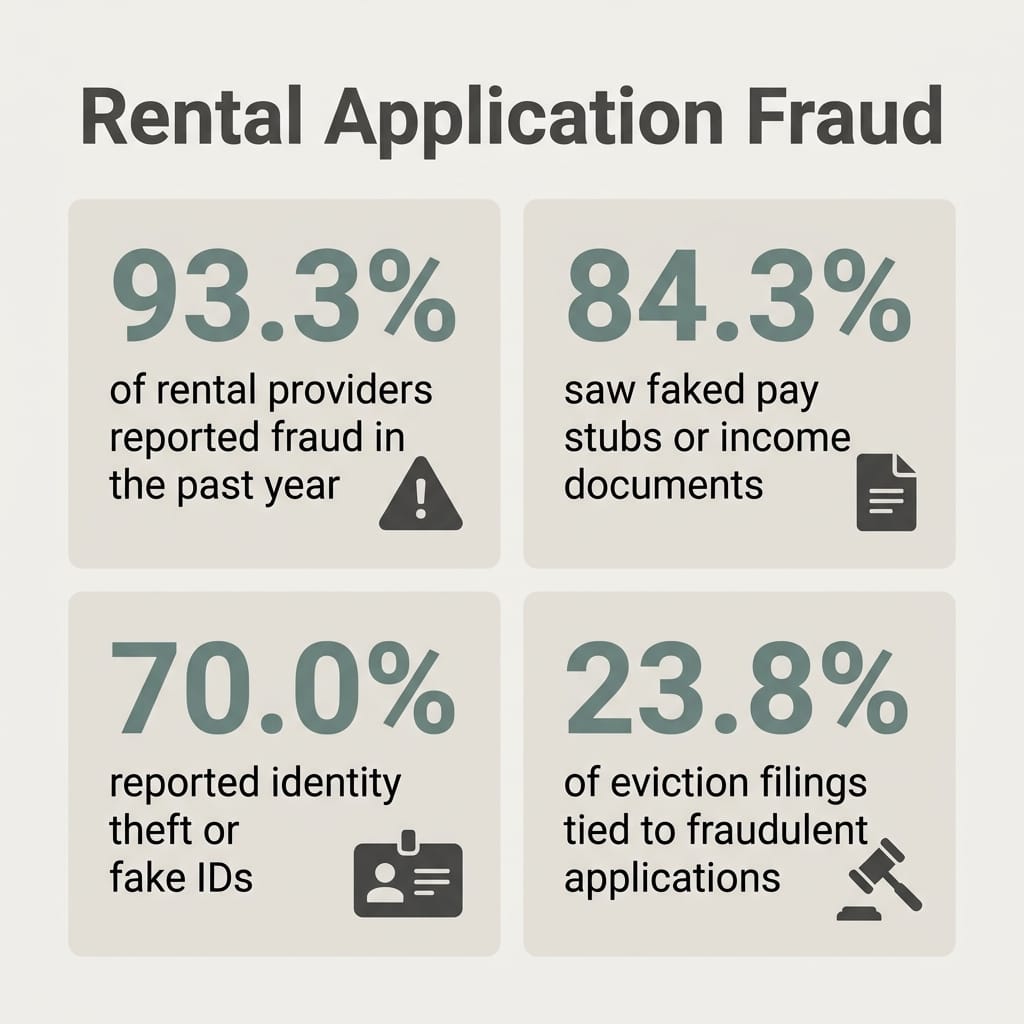
The fear is real, so size it. In a survey by the National Multifamily Housing Council, 93.3% of rental housing providers reported fraud in the past twelve months. Of those who saw fraud, 84.3% had seen faked pay stubs, employment references or other income documents. 70.0% reported identity theft, fake IDs or someone using another person's information. The cost shows up in court. On average, 23.8% of their eviction filings were tied to fraudulent applications and the unpaid rent that followed.
The document-level view agrees. Snappt, a fraud-detection company, found 6.4% of the rental applications it reviewed were fraudulent, with over 80,000 documents manipulated.
Two terms help. A credit protection number, or CPN, is a phony number some applicants use in place of a real Social Security number to hide bad credit. Synthetic identity fraud is building a fake person from a mix of real and made-up personal details. Both tend to show up as thin or brand-new credit files. A thin file alone proves nothing, though. Plenty of honest people are new to credit.
Here is the checklist, by stage. Each sign has a check that confirms it or clears it.
- Inquiry. Sign: the prospect pushes to skip the ID step or apply sight unseen. Check: require ID verification from every prospect before any tour.
- Tour. Sign: the person at the door doesn't match the ID. Check: verify the ID at the tour, before the person steps inside.
- Application. Sign: a brand-new or very thin credit file paired with high stated income. Check: confirm income through an IRS transcript and an employer call before drawing any conclusion.
- Application. Sign: a Social Security number that doesn't match the name or birth date in the report. Check: ask the applicant to explain and provide official records, the same request you would make of anyone.
- Documents. Sign: fonts that don't match on the same pay stub. Check: compare against an IRS wage and income statement.
- Documents. Sign: pay periods that don't line up from one stub to the next. Check: count the dates against the pay schedule the employer confirms.
- Documents. Sign: a year-to-date total that is exactly the same on two or more stubs. Check: real year-to-date totals grow. Ask for a transcript.
- Documents. Sign: a template field left blank, such as the word State where the actual state should be. Check: treat it as a likely edited template and verify with the source.
- References. Sign: the only employer or previous owner number is the one on the application. Check: look up the business yourself and call that number.
We start where fraud often starts: at the door. Every prospect is ID and biometrically verified before stepping inside your property. A digital lockbox is available with Tenant Placement for $100. Know the limits, too. A biometric check confirms the person. It does not check their pay stubs. Documents still need the checks above.
Get started with Hemlane
What should disqualify a rental applicant?
Reasons tied to the facts of the application hold up best: false information you verified, requested documents never supplied, income that misses your written standard. Criminal history and past evictions need care and judgment. Protected traits never belong in the decision. Write your criteria first. Then apply them to everyone the same way.
This section informs. It is not legal advice. Federal guidance has shifted, and state and local rules differ. Many are stricter than federal law.
Reasonable to disqualify | Weigh case by case | Never use |
|---|---|---|
False information on the application that you verified | Criminal records, looking at what happened, how long ago, and whether it was a conviction | Any trait protected by federal, state or local fair housing law, such as race or religion |
Requested verification not provided by your stated deadline | Eviction filings, especially ones without a judgment | A blanket ban on anyone with any criminal record |
Verified income below your written standard | A thin or new credit file | Lawful income such as a voucher, where local law protects it |
An identity you could not verify | Past late payments or old debts | Any rule you don't apply to every applicant |
On deadlines, one operator cancels applications when the applicant can't provide requested information within 72 hours. A clear deadline, stated up front and used for everyone, keeps things fair and keeps your unit moving.
Criminal history is where the federal picture moved most. The federal housing department, HUD, has withdrawn its earlier guidance on criminal records. That covers a notice to public housing agencies (Notice PIH 2015-19), a 2016 guide from its legal office and a 2022 guide from its fair housing office. Those documents had limited how owners could rely on criminal history. HUD has also said it will not use disparate-impact liability. That is the idea that a rule can be illegal if it looks neutral but falls much harder on a protected group.
That does not settle the question. The FTC still warns that a blanket policy of refusing anyone with a criminal record may violate the Fair Housing Act. Courts, states and cities can apply their own standards. Many states and cities limit criminal-history screening on their own. Check your local rules with a qualified legal source.
Now the notice. Conditional approval counts as adverse action. Requiring a co-signer, or a bigger deposit than you would ask of another applicant, is an adverse action. So is a denial. If the decision rests in any part on a consumer report, you must give notice. That notice must tell the applicant they can dispute the accuracy or completeness of the report. It must also tell them they can get a free copy from the reporting company if they ask within 60 days.
A short routine keeps you consistent:
- Write your criteria before the first application lands.
- Share them with every prospect at the inquiry stage.
- Score each file against the same list, in the same order.
- Keep notes on why you approved, conditioned or denied.
- Send the adverse action notice every time it applies.
Your coordinator reviews applications, and every one arrives complete for your decision. We don't approve or deny anyone. You do.
Frequently Asked Questions
How can owners check whether an applicant has an eviction record?
A screening report can include housing court records, including eviction cases. Don't stop there. A filing is not an eviction. If a report shows an eviction filed but not its dismissal, that record should be corrected. Errors are common. A study of over 3.6 million eviction court records from 12 states found that, on average, 22% were unclear about how the case ended or got the tenant's history wrong. Check the county court record yourself. Call the previous owner at a number you looked up.
How long does tenant screening take?
The automated part can be fast. TransUnion SmartMove, for one, says most of its background check results come back the same day once the applicant authorizes. Manual checks take longer. Mailed IRS transcripts arrive in 5 to 10 calendar days, so ask applicants to request theirs online when they can. Set a firm deadline for documents. One operator cancels applications if requested information doesn't arrive within 72 hours. On the leasing side, we cut days on market by 26% and run showings 7 days a week.
Is there a free tenant background check for owners?
Not a full one, and consent still matters. You can only get a consumer report with a permissible purpose, and written permission from the applicant shows it. Some pieces are free. Equifax, Experian and TransUnion let anyone check their own credit report once a week for free, so an applicant can pull and share theirs. A copy the applicant hands you is not verified, though, so treat it the way you would any document. Anyone can search sex offender registries for all 50 states, DC, the U.S. territories and Indian Country through the Department of Justice's National Sex Offender Public Website. Some states set their own rules. In Colorado, an owner may require that a portable screening report be no more than 30 days old. If an applicant provides one, the owner can't charge an application fee or a fee to use it. Other states handle this differently.
You set the criteria. You make the call. We take the legwork off your plate.
Manage your rentals on Hemlane
Hemlane, Inc. is a technology company that helps you manage your long-term rental properties. Communications between you and Hemlane are protected by our Privacy Policy. Hemlane also provides access to independent licensed professionals and self-help services at your specific direction. We are not a property management firm. We cannot make any decisions on behalf of any property owners. Any content found in the Hemlane Academy is not a substitute for advice and ideas from a qualified legal source or expert. You are responsible for performing additional research to confirm you are complying with all laws applicable to your rental situation.
Sources


- Federal Trade Commission — Using Consumer Reports: What Landlords Need to Know | Federal Trade Commission · retrieved October 26, 2026
- Consumer Financial Protection Bureau — CFPB Reports Highlight Problems with Tenant Background Checks | Consumer Financial Protection Bureau · retrieved November 3, 2026
- Internal Revenue Service — Get your tax records and transcripts | Internal Revenue Service · retrieved November 3, 2026
- National Multifamily Housing Council — NMHC | Rampant, Increasing Fraud Impacting Rental Housing Costs · retrieved November 3, 2026
- U.S. Department of Justice (NSOPW) — Home | Dru Sjodin National Sex Offender Public Website · retrieved November 3, 2026
- National Apartment Association — The Hunt for Red Flags | National Apartment Association · retrieved November 3, 2026
- U.S. Census Bureau — Nearly Half of Renter Households Are Cost-Burdened, Proportions Differ by Race · retrieved November 3, 2026
- Fannie Mae Selling Guide — Underwriting Factors and Documentation for a Self-Employed Borrower | Fannie Mae · retrieved November 3, 2026
- Poverty & Race Research Action Council — State and Local Source-of-Income Nondiscrimination Laws: Protections that Expand Housing Choice and Access (PRRAC, Updated March 2026)) - PRRAC — Connecting Research to Advocacy · retrieved November 3, 2026
- TransUnion SmartMove — Tenant Screening Service & Tenant Background Checks | TransUnion SmartMove · retrieved October 26, 2026
- TransUnion SmartMove — Tenant FAQs | SmartMove Rental Screening Answers | TransUnion SmartMove · retrieved November 3, 2026
- National Multifamily Housing Council — NMHC | NMHC Pulse Survey: Analyzing the Operational Impact of Rental Application Fraud and Bad Debt · retrieved November 3, 2026
- Multifamily Executive — Snappt Report: 6.4% of Rental Applications Were Fraudulent in 2024 · retrieved November 3, 2026
- Federal Reserve (FedPayments Improvement) — Federal Reserve System Announces Industry-Recommended Definition of Synthetic Identity Fraud - FedPayments Improvement · retrieved November 3, 2026
- Consumer Financial Protection Bureau — What is a tenant screening report? | Consumer Financial Protection Bureau · retrieved November 3, 2026
- Federal Trade Commission — Tenant Background Checks and Your Rights | Consumer Advice · retrieved November 3, 2026
- Cornell Law School Legal Information Institute (15 U.S.C. 1681c) — 15 U.S. Code § 1681c - Requirements relating to information contained in consumer reports | U.S. Code | US Law | LII / Legal Information Institute · retrieved November 3, 2026
- Nelson Mullins — Nelson Mullins - HUD Just Reset the Rules: Here’s What Developers and Owners Need to Know · retrieved November 3, 2026
- National Association of Realtors — HUD Withdraws Fair Housing Guidance Documents · retrieved November 3, 2026
- Consumer Financial Protection Bureau — Review your rental background check | Consumer Financial Protection Bureau · retrieved November 3, 2026
- Princeton University (Housing Policy Debate) — Inaccuracies in Eviction Records: Implications for Renters and Researchers - Princeton University · retrieved November 3, 2026
- Colorado General Assembly — HB23-1099 Portable Screening Report For Residential Leases | Colorado General Assembly · retrieved November 3, 2026
- Federal Trade Commission — You now have permanent access to free weekly credit reports | Consumer Advice · retrieved November 3, 2026
Get the Latest in Real Estate & Property Management!
I consent to receiving news, emails, and related marketing communications. I have read and agree with the privacy policy.


