
Property Lease Management Software: State Rules & Dates

Editorial Staff
Content published by Hemlane is created and reviewed by members of our editorial team, including experienced technical writers and real estate professionals.
One clause your state won't enforce. One notice sent a week late. That's all it takes for a lease to stop working for you.
Most lease trouble isn't about the tenant. It's about paperwork. Paper leases. Scattered files. A date nobody wrote down.
This isn't another list of the best software. It walks the lease in the order you live it. What the lease must say. Which parts your state controls. How to fill out a month-to-month agreement. Which dates you can't miss. How it all holds together across several properties and states.
State law drives most of the answers here. A template is a strong start. It is not legal review. You stay in charge of every lease.
Hemlane, Inc. is a technology company that helps you manage your long-term rental properties. Communications between you and Hemlane are protected by our Privacy Policy. Hemlane also provides access to independent licensed professionals and self-help services at your specific direction. We are not a property management firm. We cannot make any decisions on behalf of any property owners. Any content found in the Hemlane Academy is not a substitute for advice and ideas from a qualified legal source or expert. You are responsible for performing additional research to confirm you are complying with all laws applicable to your rental situation.
What should a residential lease agreement include?
A residential lease should name the parties, the property and the term. It should set the rent and how it's paid, the deposit, the fees and who lives there. It should say how either side ends or renews it. It should carry the required disclosures. And it should leave out any clause your state won't enforce.
Here is the checklist. Read any template against it.
Clause | What it covers and why it matters | Varies by state? |
|---|---|---|
Parties | Names of the owner and each tenant. It sets who is bound by the lease. | Rarely |
Property | Full address and unit number. No question about what was rented. | No |
Term | Start date and end date, or month-to-month. It sets when notices come due. | The notice rules do |
Rent | Amount, due date, who gets paid and where. Most disputes start here. | Sometimes |
Late and returned-check fees | The exact amount of each. A fee that isn't written down is hard to collect. | Often |
Security deposit | Amount and purpose. Caps and return deadlines are set by the state. | Yes |
Occupancy | How many people may live in the unit. A clear limit means fewer surprises. | Sometimes |
Repairs and maintenance | Who handles what, and how to report a problem. | Often |
Entry | When and how you may enter the unit. | Often |
Ending or renewing | The notice each side must give. Miss a window and a move-out or rent change stalls. | Yes |
Disclosures | Required notices, attached or written in. | Yes |
Signatures | Every party signs, on paper or electronically. | Consent rules apply |
Required disclosures. Some disclosures don't change at the state line. The U.S. Environmental Protection Agency's lead-based paint disclosure rule requires owners to share specific information about known lead-based paint and its hazards before a renter signs. You can attach the disclosure to the lease. Or you can write the language into the lease itself. Your state may add its own disclosures on top.
Clauses to leave out. A clause the law won't enforce does nothing for you. It can also start an argument you won't win. In California, for example, a lease can't say a security deposit is nonrefundable. Other states have their own banned terms. Check yours before you sign.
Our in-app leases start from state and country-specific templates. They pre-fill the listing and applicant details. You still read every clause against this list. It's a guide, not legal advice, and no single list covers every city.
How do state-specific lease templates protect owners?
A state-specific template protects you by starting from your state's rules, not a generic form. Deposit caps, void clauses and disclosure deadlines change at the state line. A generic form can break one without you noticing. The template narrows that risk. You still check the details that depend on you, your property and your city.
Here's where a generic form goes wrong.
Term that changes | One state's rule | What goes wrong with a generic form |
|---|---|---|
Void clauses | In Texas, a clause saying the owner has no duty to mitigate damages is void. | You count on a clause that won't hold when a tenant leaves early. |
Deposit caps | In California, starting July 1, 2024, the cap is one month's rent. Small owners can charge up to two months. | A deposit sized for another state breaks the cap. Your size can change the answer too. |
Federal disclosures | Lead paint information must reach the renter before signing. | Sent after signing, it's late. |
State disclosures | In Florida, you disclose the advance rent or deposit in writing, in the lease or within 30 days of receiving it. | The clock starts when the money arrives, not when you remember. |
The Texas State Law Library explains the void-clause rule in its guide to ending a lease.
Now the quieter risk. Most lease errors aren't legal. They're clerical. A misspelled name. Last year's rent. The wrong unit number. Our templates pull the listing and the applicant straight into the lease. You type it once. Then you read it.
Before you send any lease, check these:
- The template matches the state the property is in.
- The deposit fits your state's cap, and your size if your state ties the cap to it.
- Every required disclosure is attached or written in.
- No clause your state treats as void.
- City rules are checked, not just state rules.
- Names, address, rent and dates match the applicant and the listing.
You can see how our state-specific lease templates pre-fill listing and applicant details. The template does the typing. The decisions stay yours.
How do you fill out a month-to-month rental agreement?
Fill out a month-to-month agreement in the order it reads. Name the parties and the property. Set the rent, deposit, fees and occupancy. Then write the notice terms. That's where state law matters most. Attach the disclosures. Sign. If you sign electronically, get the tenant's consent to electronic records first.
Step by step:
- Parties. Write the full names of the owner and each tenant.
- Property. Give the full address and the unit number.
- Term. Say the tenancy runs month to month. Give the start date.
- Rent. Write the amount and the day it's due. Say who gets paid and where.
- Deposit. Write the amount and what it's for. Check it against your state's cap.
- Fees. Write the exact late charge and returned-check fee, if you charge them. Your state may limit both.
- Occupancy. Write how many people may live in the unit.
- Notice to end. This field carries the most risk. In California, an owner's notice ending a month-to-month rental must give an end date 30 or 60 days from the day it's given. In New York, outside New York City, the tenant must give one month's notice to end it. Write your own state's rule, not these.
- Rent changes. In California, a month-to-month increase of 10% or less needs 30 days' written notice. An increase of more than 10% needs 90 days. In New York, an owner can raise a month-to-month tenant's rent with the tenant's consent. Without consent, the path is ending the tenancy with proper notice.
- Disclosures. Attach the lead disclosure if it applies. Add any your state requires.
- Signatures. Both sides sign. Under the federal E-Sign Act, electronic records can meet a writing requirement when the tenant has affirmatively consented and hasn't withdrawn that consent. Get the consent first.
Fields your state sets: the deposit amount, late and returned-check fees, notice to end, rent-increase notice, and disclosures. Look each one up for the state the property sits in.
In Hemlane, you start from the state template for the property. The listing and applicant details fill in for you. You set the terms. You read every field. Then you send it for e-signature, no DocuSign account needed. Built-in notifications handle the reminders, so you're not chasing a signature by text.
Get started with Hemlane and build your next lease from a template.
How does lease management software track lease expirations and other key dates?
Lease software tracks key dates by tying each one to the lease and reminding you before it lands. The dates that matter most are renewal and non-renewal notice, rent-increase notice, auto-renewal notice, and move-out deposit deadlines. State law sets each window. Miss one and you can lose a rent change or a deposit claim.
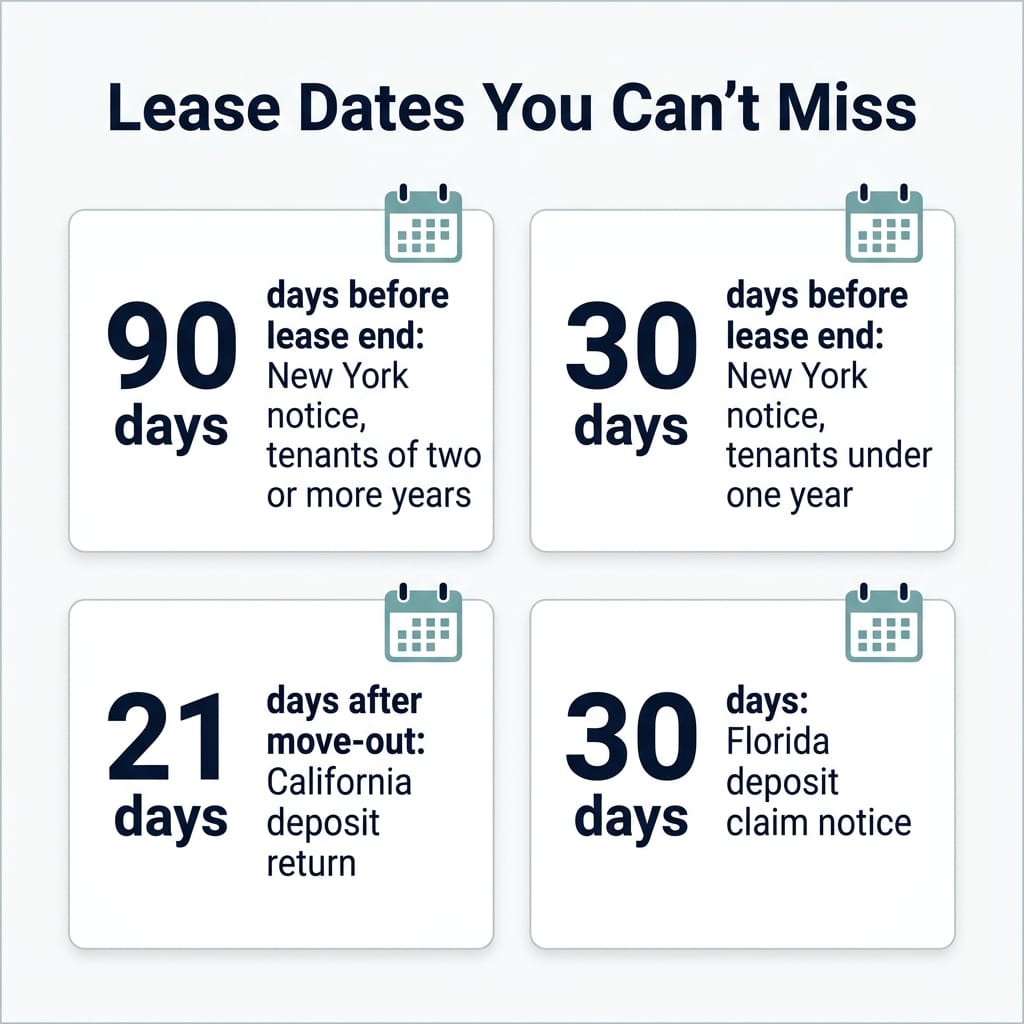
Here are the dates, with real windows from state rules.
Date | What it triggers | Example window | What missing it can cost |
|---|---|---|---|
Lease end, tenant of 2 or more years or on a 2-year lease (New York) | Written notice of a rent increase or non-renewal | 90 days before | Your increase or non-renewal is out of time |
Lease end, tenant of less than 1 year or on a shorter lease (New York) | The same notice | 30 days before | The same |
Auto-renewal clause deadline (New York) | Notice to the tenant that the clause exists | 15 to 30 days before the tenant's own non-renewal deadline | You've skipped a required notice |
Rent-stabilized renewal (New York City) | Written renewal offer, by mail or personal delivery | No more than 150 and no less than 90 days before the lease ends | Your renewal offer is outside the window |
Move-out deposit (California) | Return the deposit, or return the rest with itemized deductions | 21 days after move-out | Your deductions arrive late |
Move-out deposit claim (Florida) | Written notice of any claim on the deposit | 30 days | You forfeit the right to claim against the deposit. You can still sue for damages after returning it. |
The New York State Attorney General's residential tenants' rights guide lays out New York's notice tiers. Florida's deposit rules sit in the Florida Statutes, published by the Florida Legislature.
That Florida line is the one that stings. Thirty days pass. The deposit claim is gone.


Here's what we do. Hemlane sends renewal reminders up to 90 days before a lease expires. Our templates and e-signing come with built-in notifications. Tenant messaging by SMS and email sits in the same account. The lease, the reminder and the conversation live together.
Two honest notes. A reminder at 90 days lands right on New York's longest standard notice tier. Act on it that day, or set your own earlier reminder. A rent-stabilized unit in New York City opens at 150 days, so plan ahead of it. And deposit deadlines run from move-out, not expiration. Put them on your calendar the day the tenant gives notice.
How does lease management software handle leases across multiple properties?
Lease software handles several properties by keeping every lease, tenant record and message in one account. Each lease starts from its own state's template. It pre-fills from its own listing and applicant. You sign it in-app and store it with the tenant record. Two states still mean two rulebooks. One place keeps them from blurring.
Three doors. Two states. Two deposit clocks. In California, you have 21 days after move-out to return the deposit or send the itemized deductions. In Florida, if you're not making a claim, you return it within 15 days after the rental agreement ends. A spreadsheet holds the dates you type in. It won't tell you which rulebook a door follows.
Here's the same work, two ways.
Step | Spreadsheets and separate tools | One platform |
|---|---|---|
Drafting | An old lease file, edited by hand for each state | A state template for each property |
Filling details | Retype names, rent and address every time | Listing and applicant details pre-fill |
Signing | A separate e-sign tool and another login | E-signing in-app, no DocuSign needed |
Storing | Folders, inboxes and a filing cabinet | Document storage with the tenant record |
Renewals | Calendar entries you hope you made | Renewal reminders up to 90 days out |
Messaging | Your personal phone and email | SMS and email from the same account |
This isn't about doing it wrong before. It's about too many places to look. Five tools means five places where a date goes missing.
Hemlane handles portfolios from 1 to 2,000 units, in all 50 states. We support over 20,000 rental properties across 4,418 U.S. cities. Owners give us a 4.8 average review rating. Rent comes in with $0 ACH fees, and 100% of late fees go to you. If you want a person on tenant communication, a tenant coordinator is available if you need one.
You call the shots on every lease. We handle the paperwork and the reminders.
Running leases for many owners? Our software for property managers keeps each owner's leases and tenants straight, so you can grow the portfolio without adding staff. Want to see leases next to rent collection, screening and repairs? See how it fits in one account.
Manage your rentals on Hemlane.
Frequently Asked Questions
How can tenants access their signed lease agreement online?
Tenants can open their signed lease in Hemlane's tenant portal. It gives renters instant lease access, along with their payments and messages in one place. That cuts the calls asking for a copy. Your state may still set a deadline for handing over a copy, so know yours.
In Texas, an owner must give the tenant a copy of a written lease within 3 business days of signing. A co-tenant who hasn't received a copy must get one within 3 business days of a written request. In New York City, rent-stabilized tenants are entitled to a fully signed copy within 30 days of the owner receiving the lease signed by the tenant. Other states set their own rules.
Signing electronically? The federal E-Sign Act's disclosures must tell the tenant how to request a paper copy, and whether there's a fee for it.
How do owners add a pet addendum to an existing lease?
Write the pet terms as an addendum. Have both you and the tenant sign it. Agreed changes belong in the signed agreement, not in a text thread. Before you set a pet deposit, check your state's deposit rules. And treat assistance-animal requests separately from pets.
Deposits first. In California, a pet deposit counts as part of the security deposit, whatever you call it. The cap has no pet exception. A pet deposit on top of a full deposit can break it.
Assistance animals next. On May 22, 2026, HUD's Office of Fair Housing and Equal Opportunity announced it is permanently rescinding its 2020 notice on assistance animals. That changes the federal view. A request to waive your pet policy for an untrained emotional support animal is no longer treated as reasonable by default. State and local laws are not affected by that change. Your state or city may require more. Get qualified advice on any specific request.
Keep the signed addendum in Hemlane's document storage, next to the lease and the tenant record.
What happens when a tenant breaks a lease early?
What you can recover depends on your state and the tenant's reason. Some states, like Texas and California, expect you to try to re-rent. Some reasons, like military orders, give the tenant a legal right to leave. The deposit can cover unpaid rent. Recovering the rest is rarely quick or certain.
In Texas, you must try to find a new tenant to reduce the rent the former tenant owes. A lease clause waiving that duty is void. In California, owners have a duty to mitigate damages under Civil Code 1951.2.
Military moves follow federal law. The U.S. Department of Justice explains servicemembers' housing rights under the SCRA. With monthly rent, once the tenant gives proper notice and a copy of the orders, the lease ends 30 days after the next rent payment is due. The right covers a lease signed by someone who later enters service. It also covers someone in service who later gets permanent change of station orders or deployment orders of at least 90 days. The Department of Justice treats making servicemembers repay rent concessions or discounts as an early termination fee that violates the SCRA.
States add their own protected reasons. In Texas, a family-violence survivor must give documentation and 30 days' written notice to move out.
Then the deposit. It's usually 1 to 2 months' rent. It's held in case the tenant damages the unit, or breaks the lease and doesn't pay rent. Your state's return and itemizing rules still apply.
Talk early. Use SMS and email messaging to keep the conversation in writing, with a tenant coordinator available if you need one. This is general information, not legal advice.
Your leases. Your decisions. Our paperwork. Get started with Hemlane.
Sources


- U.S. Environmental Protection Agency — Real Estate Disclosures about Potential Lead Hazards | US EPA · retrieved November 3, 2026
- Texas State Law Library — Ending the Lease - Landlord/Tenant Law - Guides at Texas State Law Library · retrieved November 3, 2026
- New York State Attorney General — Residential Tenants’ Rights Guide | New York Attorney General · retrieved November 3, 2026
- Florida Legislature (Florida Statutes s. 83.49) — Statutes & Constitution :View Statutes : Online Sunshine · retrieved November 3, 2026
- U.S. Department of Justice, Civil Rights Division — Servicemembers and Veterans Initiative | Financial and Housing Rights · retrieved November 3, 2026
- California Department of Real Estate — Publications and Reports · retrieved November 3, 2026
- Judicial Branch of California, Self-Help Guide — Types of eviction notices landlords | California Courts | Self Help Guide · retrieved November 3, 2026
- Legal Services of Northern California — I received notice that my rent is increasing. Can my landlord do this? | Legal Services of Northern California · retrieved November 3, 2026
- National Credit Union Administration — Electronic Signatures in Global and National Commerce Act (E-Sign Act) | NCUA · retrieved November 3, 2026
- Judicial Branch of California, Self-Help Guide — Guide to security deposits in California | California Courts | Self Help Guide · retrieved November 3, 2026
- Texas State Law Library — Leases - Landlord/Tenant Law - Guides at Texas State Law Library · retrieved November 3, 2026
- Holland & Knight — HUD Rescinds Emotional Support Animal Guidance | Insights | Holland & Knight · retrieved November 3, 2026
- Bay Legal — My Tenant Broke Their Lease. Do I Have to Find a New Renter in California? · retrieved November 3, 2026
Get the Latest in Real Estate & Property Management!
I consent to receiving news, emails, and related marketing communications. I have read and agree with the privacy policy.


