Pennsylvania Landlord-Tenant Law Explained: Rights, Responsibilities, and Rental Rules

Choosing the proper tenancy structure is the easiest way to protect your property, reduce turnover, and comply with Pennsylvania landlord and tenant rights. Each lease type affects landlord-tenant dynamics, including notice periods, renewal guidelines, rent increases, and the removal of a problematic tenant. When landlords get this wrong, you spend more time arguing about technicalities than enjoying the passive income you planned for this business.
Get it right, and your policies, screening, and systems do the work for you. We’ll categorically break it down in this article.
Types of Tenancies in Pennsylvania
Periodic tenancy (month-to-month)The agreement renews automatically (usually on a monthly basis) until either party provides written notice of termination. This type of agreement is ideal if you want flexibility to adjust rent, end a bad fit, or respond quickly to changing market conditions.
Fixed-term leaseA fixed-term runs for a defined term. Twelve months is usually the standard, but it can be determined any timeframe that’s mutually agreed upon. As the termination date approaches, landlords and tenants can agree to a lease renewal, and/or negotiate any revised terms to take effect in the new agreement. A fixed-term lease provides stability in cash flow and occupancy, and is particularly enjoyable when it’s combined with proper tenant screening and clear lease terms.
Year-to-year leaseSimilar to a fixed-term lease, a year-to-year lease automatically renews every year unless notice is given. Year-to-year leases are helpful for long-term, reliable tenants, but a solid tracking system is advised. If you’re managing multiple units, you need to avoid missing notice windows as the renewal approaches.
Tenancy-at-willVery loosely structured, a tenancy-at-will agreement can be terminated at any time, often with minimal notice. It’s easy to start, but very risky to manage. Most landlords are better served with a written fixed-term or periodic lease to keep expectations clear.
Discrimination is Prohibited (Obviously)
Under the federal Fair Housing Act and the Pennsylvania Human Relations Act, landlords must apply Pennsylvania landlord and tenant rights fairly. For example, you cannot refuse to rent, change terms, or treat someone differently because of race, color, national origin, religion, sex, familial status (including pregnancy), disability, or age, or because they use assistance animals or lawful public assistance.
Examples of illegal conduct include, but are not limited to, rejecting families with children, charging higher rent or deposits based on an immutable trait, refusing reasonable disability accommodations or modifications, and/or harassing or retaliating against tenants who assert PA tenant rights.
If you want to avoid a discrimination problem, use consistent and objective screening criteria, standard written policies, and documented decisions in accordance with landlord-tenant law in PA. Suspected violations should be reported to the Pennsylvania Human Relations Commission or HUD, where tenants may seek compensation and corrective action.
Constructing a Lease
Under Pennsylvania landlord-tenant rights, both written and oral leases are binding. Serious landlords should treat a written lease as non-negotiable. A clear lease, backed by consistent screening and online rent systems, is your best defense against disputes.
Written leases
A written lease under landlord-tenant law in PA should clearly cover:
- Names of all adult tenants
- Property address
- Lease term and rent due dates
- Rent amount, late fees, and other charges
- Landlord’s name and address
- Which utilities and services each party covers
- Pet, smoking, guest, and parking rules
- Lead-based paint disclosure if required
- Any automatic renewal language
Prohibited clauses
Pennsylvania law and the PA Landlord and Tenant Act do not allow clauses that waive habitability duties, excuse landlord negligence, allow “confession of judgment*,” or let you seize a tenant’s belongings for unpaid rent.
*A confession of judgment is a lease or contract clause where the tenant pre-authorizes the landlord’s attorney to go to court and enter a judgment against them without notice, a hearing, or a chance to defend. In Pennsylvania, such a clause is not permitted in residential leases (only tightly regulated in commercial deals). If you see it in a residential lease, treat it as a red flag.
Oral leases
Oral agreements are legally binding but risky because they’re difficult to prove, easy to misremember, and unenforceable if not in writing. After an oral agreement is established, confirm it with a written lease to ensure that Pennsylvania tenant rights are followed and your own protections are explicitly outlined.
Lease renewals
For fixed-term leases, provide written non-renewal notice well in advance, or the lease may automatically renew.
- 12+ months = 3 months’ notice
- 6–12 months = 1.5 months’ notice
- 1–6 months = 1 month’s notice
Track these dates systematically (ideally in your property management software) so renewals, increases, and terminations happen on your terms, not by accident or with friction.
Tenant Rights and Responsibilities (What Landlords Should Expect)
Pennsylvania landlord-tenant rights entitle renters to a safe and habitable home, and landlords are entitled to tenants who follow the lease. That means basics like heat, water, electricity, weatherproofing, working locks, and structurally safe conditions are expected from landlords. Tenants are expected to pay their rent on time, treat the unit with care, and refrain from causing damage beyond normal wear and tear.
If serious issues arise (such as no heat, sewage leaks, or unsafe wiring) and you ignore written notice, tenants may explore remedies, including rent withholding or repair-and-deduct, under landlord-tenant law in PA. For landlords, diligently documenting issues brought up by your tenant and responding quickly is your best protection. In return, tenants are expected to follow the house rules, refrain from engaging in illegal activities, and manage their guests to prevent unauthorized occupancy.
Keep in mind that for month-to-month and other periodic tenancies, the same PA tenant rights apply. The Pennsylvania Office of Attorney General’s Consumer Guide confirms that landlords must follow statutory notice rules (10/15/30 days depending on cause and lease term) and use the court process of “no lockouts” and no “self-help.”
Landlord’s Rights and Responsibilities
For landlords, Pennsylvania recognizes that you’re running a business, not a charity. You get fundamental rights if you meet your obligations.
Those obligations are:
- Provide a habitable, code-compliant property
- Safe structure
- Heat
- Hot water
- Electricity
- Sanitation
- Timely repairs when something essential breaks
Landlords have the right to access the unit with reasonable notice (commonly 24 hours, except emergencies), screen tenants using objective criteria under landlord-tenant law in PA, and to set clear rules on noise, pets, parking, and guests as long as they apply to everyone equally and don’t violate PA tenant rights or fair housing laws.
Ending a Lease in Pennsylvania
Ending a lease cleanly is a notable aspect of Pennsylvania landlord-tenant rights. Most of the time, providing clear notice in accordance with the statutes and avoiding “surprise” holdovers or illegal lockouts will keep things smooth.
For fixed-term leases, the agreement typically ends on the stated date, and no additional notice is required unless the lease specifies otherwise. For month-to-month and other periodic tenancies, if the lease is silent, landlord-tenant law in PA (68 P.S. § 250.501) and the Pennsylvania Attorney General’s Consumer Guide point to written notice tied to the term length. Typically, 15 days for a tenancy of one year or less (including most month-to-month leases) and 30 days for more than one year.
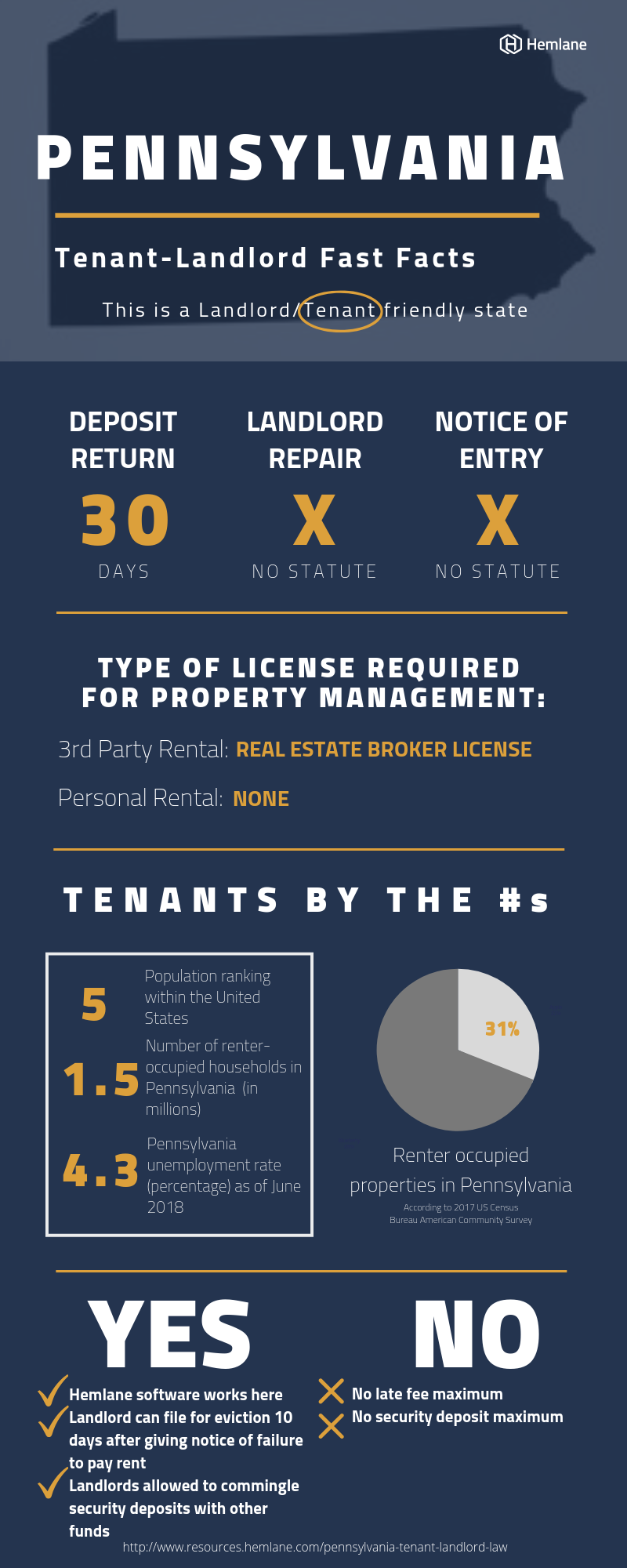
Early termination is only automatic in limited cases, such as certain domestic violence situations, condemnation/uninhabitable conditions, or serious landlord violations. Otherwise, a tenant who leaves early can still owe rent until you find a replacement tenant. When the tenancy ends and possession is returned, you must return the security deposit in accordance with the 30-day rule and provide itemized lawful deductions (such as unpaid rent or damage beyond normal wear and tear). You must also return the balance, and failing to do so within 30 days may result in double damages under Pennsylvania law.
Rent Increases and Fees
Pennsylvania has no statewide rent control, so landlords can raise rent to market rates at the end of a lease term, provided they follow notice rules and comply with fair housing laws. For specifics, refer to the Pennsylvania landlord and tenant rights handbook.
You generally cannot increase rent mid-lease unless the tenant agrees in writing or the lease includes an explicit escalation clause. For month-to-month tenants, provide written notice tied to the rental period (commonly at least one whole rental period) before any increase takes effect.
Reasonable fees are allowed if they are outlined in the lease:
- Security deposits: follow state caps (up to two months’ rent in year one, then one month).
- Late fees: permitted when specific, reasonable, and in the lease.
- Returned check fees: allowed within a typical disclosed range.
- Screening/application fees: allowed to cover actual screening costs, not junk fees.
- Damage/cleaning: only for unpaid rent or damage beyond normal wear and tear, documented and itemized at move-out.


Pennsylvania does not prohibit other standard landlord fees, such as month-to-month premiums, pet fees (where applicable), amenity fees, or early termination fees. As long as they follow the theme of being lawful, transparent, and clearly outlined in the lease agreement, you have every opportunity to define your rent amount and fee terms.
Pennsylvania Security Deposit Laws
Security deposits are a feature of Pennsylvania landlord and tenant rights, as they protect property and provide tenants with clarity on expectations.
Collection and amount
- In your first year, you can collect up to two months’ rent.
- Second year and beyond is capped at one month,
- After five continuous years, you can’t increase the deposit even if the rent goes up.
Use of security deposits
- Apply only to unpaid rent, unpaid fees listed in the lease, or damage beyond normal wear and tear.
- Do not treat the deposit as extra rent or use it for routine, expected cleaning.
Holding requirements
- If you hold more than $100 for over two years, it must be in an interest-bearing escrow at a regulated institution, with interest paid to the tenant minus a 1% admin fee.
- Keep funds separate from operating cash and provide written notice of where the deposit is held.
Returning deposits
- Within 30 days after the tenant returns possession, send an itemized list of deductions, along with the remaining balance.
- Miss the 30-day deadline and you risk losing your right to withhold anything.
Disputes and penalties
- Tenants can challenge improper deductions in the magisterial district court.
- If you ignore Pennsylvania security deposit laws, a court can order up to double the wrongfully withheld amount.
Repairs and Habitability
Every rental unit comes with an implied warranty of habitability, and landlords are required to maintain units that are safe, functional, and code-compliant. In return, tenants must report issues and allow access for repairs.
Landlord repair obligations
- Maintain a safe structure (roof, walls, floors, and stairs), essential systems (heat, electricity, plumbing, sanitation, and ventilation), and any appliances you provide (oven, refrigerator, washer/dryer, dishwasher).
- Maintain common areas to ensure they’re clean, safe, and well-lit.
Tenant remedies
- Suppose serious issues are not resolved after proper written notice. In that case, tenants may use the limited repair-and-deduct option (up to one month’s rent) or partial rent withholding tied to the unusable space.
- In severe, unresolved cases, tenants may be able to break the lease without penalty under landlord-tenant law in PA.
Notice and process
- Tenants must provide clear written notice and a reasonable amount of time to cure before withholding or deducting; otherwise, they risk being in breach.
- Landlords should log requests, respond quickly, and document all work to comply with PA tenant rights and protect against claims.
No retaliation
- You cannot raise rent, cut services, or evict in retaliation for good-faith repair requests or code complaints.
- Retaliation claims can be avoided with timely maintenance and consistent enforcement of neutral policies.
Evictions Guidelines
Landlords can only evict for lawful reasons such as nonpayment of rent, serious lease violations, significant damage, illegal activity, or holding over. That being said, only through the court process, and never by “self-help,” can an eviction occur. That means proper notice, along with a court order, must be given before anyone is evicted.
Providing adequate notice under landlord-tenant law in PA (68 P.S. § 250.501) generally requires:
- 10 days for nonpayment of rent.
- 15 days for other breaches or termination if the tenant has been in the property for less than one year.
- 30 days for other breaches or termination if the tenant has been in the property for one year or more.
If the tenant doesn’t cure or leave after the Notice to Quit, you file an eviction (Landlord–Tenant Complaint) in magisterial district court.
You cannot change locks, shut off utilities, or remove belongings on your own, as these actions are considered illegal lockouts and can result in the tenant filing claims against you. Keep the property habitable, document notices and payments, follow the 10/15/30-day timelines, and let the sheriff enforce the judgment once the court rules in your favor.
To make a long story short, don’t take matters into your own hands.
Pennsylvania Squatters’ Rights
Under Pennsylvania landlord and tenant rights, “squatters’ rights” stem from adverse possession law, which is designed to reward owners who actively monitor their property, rather than to facilitate someone taking possession of a house without permission.
In most cases, a squatter must prove that their possession was actual, open, notorious, exclusive, hostile (without permission), and continuous for 21 years (with limited exceptions of up to 10 years for small residential lots).
For landlords, the playbook is straightforward.
- Inspect and maintain your properties regularly.
- Post and enforce clear boundaries.
- Document any use in writing (so it’s permissive, not hostile).
- Take prompt action by serving proper notices and filing for eviction if someone takes possession without your consent.
- Let law enforcement take it from there.
If a squatter ever claims ownership, they still have the burden to file in court and prove every element, like documented inspections, photos, tax records, and any written permissions, which usually make their claim easy to defeat.
Resources for Landlords and Tenants
If you want to go deeper than this overview of Pennsylvania landlord and tenant rights, here are some great state and local resources:
- Hemlane: Pennsylvania Landlord-Tenant Law Guide – Practical breakdown of leasing, notices, rent rules, and compliance.
- Hemlane: Pennsylvania Security Deposit Laws – Detailed rules on collection limits, holding requirements, timelines, and double-damages risk.
- Pennsylvania Office of Attorney General
- Bureau of Consumer Protection
- Fair Housing Commission
- Philadelphia Tenant Union
- Pennsylvania Residential Owners Association
- Pennsylvania Human Relations Commission
Don’t risk costly mistakes with Pennsylvania rental laws. Use Hemlane to automate lease tracking, tenant screening, and rent collection all while staying compliant. Sign up today!
Frequently Asked Questions
What rights do renters have in Pennsylvania?
Renters have the right to a safe, habitable home, freedom from discrimination, and reasonable privacy (with notice before entry except in emergencies), all protected under Pennsylvania landlord and tenant rights and fair housing laws.
What are the obligations of a landlord in Pennsylvania?
Landlords must keep the property habitable and code-compliant, make timely repairs, follow security deposit rules, respect privacy with reasonable notice, and comply with landlord-tenant law in PA and fair housing requirements.
What is the tenants’ rights organization in Pennsylvania?
The Pennsylvania Legal Aid Network (PLAN) and local legal aid programs provide free help with evictions, repairs, discrimination, and other landlord-tenant disputes for qualifying tenants.
Can a landlord evict you without a lease in Pennsylvania?
Yes. Month-to-month or other “no written lease” tenancies can be terminated with proper written notice (typically 15 or 30 days, depending on the length of occupancy) followed by a court-filed eviction if the tenant fails to vacate.


How much notice does a landlord have to give a tenant to move out in Pennsylvania?
For most month-to-month setups: 15 days if the tenant’s been there under one year, 30 days if one year or more; week-to-week usually requires 7 days; fixed-term leases follow the notice terms in the written agreement.
Get the Latest in Real Estate & Property Management!
I consent to receiving news, emails, and related marketing communications. I have read and agree with the privacy policy.


