
Online Rental Property Management Software: Repair Guide

Editorial Staff
Content published by Hemlane is created and reviewed by members of our editorial team, including experienced technical writers and real estate professionals.
Tenants don't call about repairs during business hours. Leaks don't wait for Monday. And the 2 AM water heater call is real.
Most owners run repairs alone. They juggle a notes app, a text thread, a spreadsheet and a plumber's cell number. One missed task can turn into one big bill.
This guide gives you a working system. You get a preventive calendar and a clear line between emergencies and routine repairs. You get written rules that keep you in charge of every repair dollar, plus a contractor checklist. You also see what online property management software should do for maintenance, and where a person has to take over.
How can owners cut rental maintenance costs with preventive maintenance?
Do the small, cheap tasks on a schedule so the big failures never start. Preventive maintenance means you service a system before it breaks. Reactive maintenance means you pay for the break, the rush job and the damage. Put the tasks below on a calendar. Tie each one to a property. Keep a record of every visit.
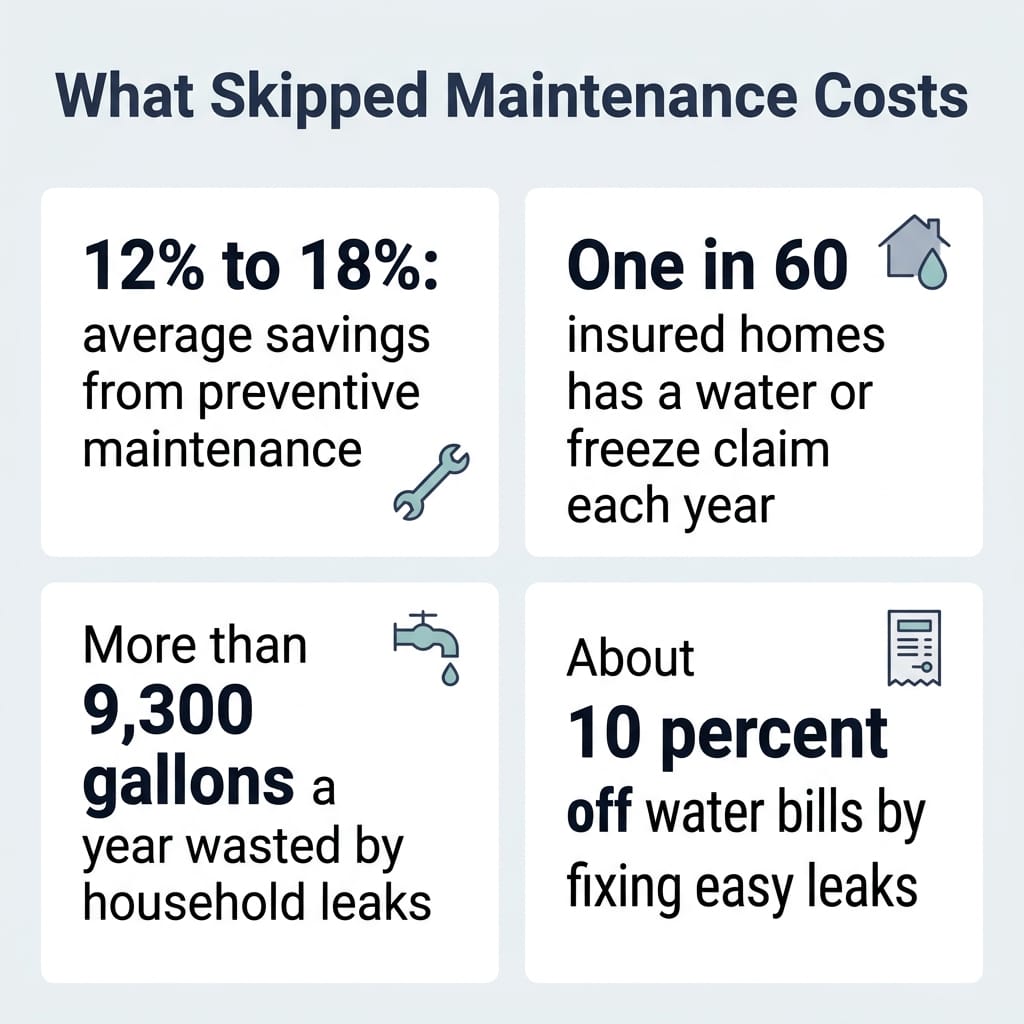
The savings are real. Federal research on building maintenance found preventive programs can save as much as 12% to 18% on average over fixing things only when they fail. That research looked at facilities, not rentals. The logic still holds for a single-family home or a fourplex.
Water is the failure to fear most. About one in 60 insured homes has a claim for water damage or freezing each year. Hidden leaks cost money too. The average household's leaks can waste more than 9,300 gallons a year. Nine percent of homes have leaks that waste 50 gallons or more a day. Fixing the easy ones can cut a water bill by about 10 percent.
A filter costs little. A failed system costs a lot more. Here is the calendar.
System | Task | How often | The costly failure it prevents |
|---|---|---|---|
HVAC | Check the filter. Replace it when dirty. | On a set schedule you keep | Higher energy bills and equipment that fails early |
HVAC | Contractor check-up on the cooling system | Every spring | A dead AC in the first heat wave, when contractors are booked |
HVAC | Contractor check-up on the heating system | Every fall | No heat in winter, when contractors are busiest |
HVAC | Have the condensate drain checked | At each seasonal check-up | Water damage and indoor humidity problems |
Water and plumbing | Check toilet flappers for a good seal | Periodically | Silent running leaks that pad the water bill |
Water and plumbing | Replace toilet flappers | At least every five years | Worn rubber that stops sealing |
Water and plumbing | Look for drips, running toilets and damp spots | At every visit | Hidden leaks and slow water damage |
Life safety | Test smoke alarms | Every month | An alarm that stays silent in a fire |
Life safety | Replace 9-volt smoke alarm batteries | At least once a year | Dead batteries |
Life safety | Replace smoke alarms | Every 10 years | Alarms that have worn out |
Life safety | Test CO alarms and replace their batteries | Test monthly, batteries yearly | Carbon monoxide no one detects |
Exterior | Clean the gutters | Twice a year | Overflow that sends water toward the house |
Laundry | Clean the lint filter | After every load | Dryer fire |
Laundry | Inspect and clean the dryer exhaust vent | Once a year | Dryer fire |
Water heater | Flush the tank | On a recurring schedule you set | Lost performance and a shorter tank life |
The dryer line matters more than it looks. Dryer fires cause over $100 million in property losses every year. Tell tenants at move-in to clean the lint filter after each load. Book the vent yourself.
When to stop repairing and replace
Age and repair history tell you. Consider replacing a heat pump or air conditioner once it is more than 10 years old. Frequent repairs plus rising energy bills are the other warning sign. You can only spot that pattern if you kept the record.
How to keep the plan running
A plan in your head gets forgotten. A plan on a calendar gets done. Log every visit against the property it belongs to.
Some software lets owners add tasks themselves for this reason. TurboTenant, for example, describes logging maintenance so you always know the last time you replaced an appliance or fixed the water heater. That history is what tells you a system has earned its replacement.
In Hemlane, tenant repair requests, work orders and repair tracking live in one place. Our plans include document storage and full rental accounting: bank sync, cash flow report and income statement. The receipts, the repair history and the money sit in one login. See how the Hemlane platform fits together.
What counts as a maintenance emergency in a rental property?
An emergency threatens someone's safety or is damaging the property right now. A gas smell, fire or water pouring in all qualify. Urgent problems are serious but can wait hours, not weeks. Everything else is routine. Sort every call into one of three tiers. The 2 AM panic gets smaller fast.
Life safety comes first. Then the repair. Then the paperwork.
Smell gas? Get out first. The Pennsylvania Public Utility Commission tells people to leave the building immediately. Then call 9-1-1 and the gas utility from a safe distance, away from the odor. The owner hears about it after. Put these steps in every move-in packet.
Tier | Example problems | Tenant does first | Owner does first |
|---|---|---|---|
Emergency | Gas smell. Fire or smoke. Water pouring in that won't stop. | Get out if unsafe. Call 9-1-1, and the gas utility for gas, from outside. Then report it. | Confirm everyone is safe. Get a pro dispatched now. Document the damage. |
Urgent | A roof leak in the rainy season. No hot water. A slow leak leaving wet floors or walls. | Report it right away with a clear description. Contain the water if safe. | Get it fixed within hours or days. Make sure wet areas get dried. |
Routine | A dripping faucet. A running toilet. A sticky door or cabinet. | Submit a request. | Schedule it in normal hours. Bundle small jobs into one visit. |
What the law calls serious varies by place. In California, state real estate guidance lists a roof leak in the rainy season, no hot running water or a gas leak as examples of serious defects. Other states and cities set their own rules and timelines. Check the rules where your property sits. This is general information, not legal advice.
Water sits in the urgent tier for a reason. It is rarely life-threatening. It is always time-sensitive. Damp or wet surfaces should be completely dry within 24 to 48 hours, and the source of the leak fixed. Wait longer and mold becomes the next bill. With about one in 60 insured homes filing a water or freeze claim each year, this is the call you will get.
The real question is who picks up at 2 AM. On Hemlane's Essential and Complete plans, our 24/7 Repair Coordination team handles tenant requests after hours and on weekends. Essential includes a dedicated repair coordinator, 24/7 emergency support and state-specific lease documents. You set the rules. We take the call. You stop being on call. See how 24/7 maintenance coordination works.
Get started with Hemlane
How does property management software handle maintenance requests and work orders?
Software logs the request, routes the work order and tracks status. It does not pick up the phone, troubleshoot with a tenant or chase a plumber who went quiet. That part takes a person. Here is one repair from start to finish. Each step shows who does the work and where you decide.
- The tenant submits a request. Software does this step. A good request captures the unit, a description of the problem, photos or video when available and how urgent it is. That is the standard Buildium sets out in its workflow guide. Hemlane gives tenants an online request portal for this.
- Someone reads it and sorts it. Here many tools stop. On TurboTenant, the owner gets an email when a tenant submits a request. From there it's on you, at whatever hour it arrives. On Hemlane's Essential and Complete plans, our coordination team handles requests after hours and on weekends. We pick up, troubleshoot and dispatch so you don't have to.
- You approve the repair. The owner decides. A coordinator brings you the problem and the options. You give the yes, inside the rules you wrote down.
- A work order goes to a vendor. Software builds the work order. Buildium's guide says it should hold the issue, the exact location, the assigned vendor, the expected timeline, the cost estimate, any photos and the notes from triage. On TurboTenant, sending a work order emails the job details to the maintenance worker. Hemlane lets you assign work orders to vendors and manage your vendor list in the same place.
- The visit gets scheduled. This is coordination work. Someone has to match the tenant's availability with the vendor's. Real-time status tracking in Hemlane shows you where the job stands without a phone call.
- The work gets done and closed out. A person confirms it. Buildium's guide says closing a request should record the work performed, the completion date, the final cost, the tenant's confirmation and before-and-after photos when they apply. Without that record, a dispute becomes your word against someone else's.
- The invoice gets paid. You check it against the estimate. Hemlane invoices and pays for repairs with no markups. The bill you see is the bill for the work.
- The cost lands in your books. Record every repair against the property. The IRS tells rental owners to separate the costs of repairs and improvements and keep accurate records. A clean record now saves a scramble at tax time. In Hemlane, owner reports such as cash flow, income statements and tax-ready Schedule E reports are generated from the property ledger. See how repair costs show up in your financial reports.
Software alone covers the request, the work order and the books. Sorting, scheduling and closeout are where repairs stall, because they need someone to answer. Step 3 is always yours.
We have done this at scale. Hemlane has completed 61,218 service requests, and users rate us 5 stars. Read more about the team behind the coordination.
Manage your rentals on Hemlane


How do owners keep control of repair costs when someone else coordinates maintenance?
Write your rules before the first repair call. Set an approval limit, require written estimates, define what counts as an emergency, pay only for finished work and demand itemized invoices. Then whoever coordinates works inside your limits. You keep the yes. And nobody adds a markup between the vendor's bill and yours.
Let's name the money first. Some management models earn on your repairs. A markup on the vendor's invoice. A trip fee before anyone touches the problem. A coordination charge on top. You see one number and never the real cost of the work.
We don't do that. Hemlane invoices and pays for repairs with no markups. That money is yours.
Put your spending rules in writing before the first repair call. Then everyone knows where your yes starts.
- Put repair authority in writing. Regulators expect this. The North Carolina Real Estate Commission, for example, says a management agreement should spell out authorization for repairs, and that managers should operate within the authority the written agreement grants. That is one state's rule, not a national one. The idea works everywhere: if it isn't written, it isn't authorized.
- Set your approval limit. Pick a dollar amount that fits your property and your cash. Below it, routine work can proceed. Above it, nothing moves without your yes.
- Define emergency authority. Write down what can be done without you when safety or active damage is at stake. Write down how fast you get told after. This keeps a 2 AM fix from becoming a blank check.
- Require written estimates. A written estimate should describe the work, the materials, the completion date and the price. For bigger jobs, get more than one. Compare scope, not just totals.
- Pay the final bill only for finished work. Federal consumer guidance is clear: never make the final payment until the work is done and you are satisfied with it. Photos and the tenant's confirmation are how you know.
- Require a documented closeout. Ask for the work performed, the completion date, the final cost, the tenant's sign-off and before-and-after photos. Now every bill has proof attached.
- Insist on itemized invoices. Itemized bills show exactly what you paid for. They also matter at tax time. The IRS has a rule for small costs. It's called the de minimis safe harbor. If you don't have what the IRS calls an applicable financial statement, you may be able to deduct up to $2,500 per invoice or item. The invoice is your proof. Whether it fits your situation is a question for your tax professional. Either way, a vague bill helps no one.
- Review spending in your reports. Hemlane's plans include full rental accounting with bank sync, a cash flow report and an income statement. Check your repair spend by property every month. Patterns show up fast.
On the Essential plan, a dedicated repair coordinator does the legwork inside these rules. We are not a property management firm. We make no decisions on your behalf. You call the shots, we handle the rest.
How should owners vet contractors for rental repairs?
Check the license, the insurance and the complaint history before you hire. Get written estimates and a written contract. Walk away from cash-only deals, full payment up front, and anyone who asks you to pull their permits. Do this once, before the emergency, and you build a vendor list you can trust at 2 AM.
The Federal Trade Commission sets out the baseline checks. Here is the checklist, one item at a time.
- Verify the license with your state or county. Rules differ by state. In Georgia, contractors who offer residential or general contractor work for pay must be licensed. Look up your own state's requirement.
- Use your state's lookup tool if it has one. In Washington, the Department of Labor & Industries Verify tool shows whether a business has an active contractor registration. It also shows whether its workers' comp account covering employees is active and paid to date. Many states keep a similar public record.
- Ask for proof of insurance. Get the certificate, not a promise. If they have employees, confirm workers' comp too.
- Search for complaints. Search the company's name with words like scam, review or complaint. Check with your local Home Builders Association and consumer protection officials.
- Get several written estimates. Each one should list the work, the materials, the completion date and the price. Now you can compare like with like.
- Get a written contract. Even if your state doesn't require one, ask for it.
- Red flag: cash only or everything up front. Scammers ask you to pay for it all at the start or only accept cash. End the conversation.
- Red flag: you pull the permits. A contractor who asks you to get the required building permits is pushing their job onto you. Walk away.
The point is to vet once, not every time. Build your list while nothing is broken. The worst time to check a license is with water on the floor.
Hemlane's maintenance software includes vendor management, so your vetted list lives next to your work orders. On the Complete plan, you can also get optional access to our vetted repair network.
Frequently Asked Questions
Can owners use their own contractors with online property management software?
Usually, yes. Most tools let you send work to a vendor you choose. TurboTenant, for example, lets you send a work order by entering your maintenance worker's email address. In Hemlane, you assign work orders to vendors and manage your vendor list in one place. Our vetted repair network is optional and offered on the Complete plan. Keep the plumber you trust.
Can tenants submit maintenance requests with photos online?
Many portals allow it. TenantCloud, for example, lets tenants attach photos and a short video. Avail notes that photos can cut back-and-forth messages and save several trips to the rental. Hemlane offers an online tenant request portal for repairs. Whatever the tool, teach tenants what a useful request holds: the unit number, a clear description, photos or video if possible, how urgent it is and when they are home for an appointment. Buildium's guide lists the same items. A good request means fewer wasted trips.
How fast should an owner respond to a tenant repair request?
There is no single national deadline. It depends on your state, your city and how serious the problem is. In Texas, the Texas Attorney General explains that the law presumes seven days is a reasonable time to repair, though the owner can rebut that presumption. Other states set their own rules. Water can't wait that long. Wet surfaces should be dry within 24 to 48 hours. On Hemlane's Essential and Complete plans, our 24/7 Repair Coordination team handles tenant requests after hours and on weekends. This is general information, not legal advice. Check the rules where your property sits.
Put the calendar in place. Sort calls into three tiers. Write your spending rules. Vet your vendors before you need them. Then let someone else take the 2 AM call while you keep every decision. All of the control, none of the chaos.
Get started with Hemlane
Hemlane, Inc. is a technology company that helps you manage your long-term rental properties. Communications between you and Hemlane are protected by our Privacy Policy. Hemlane also provides access to independent licensed professionals and self-help services at your specific direction. We are not a property management firm. We cannot make any decisions on behalf of any property owners. Any content found in the Hemlane Academy is not a substitute for advice and ideas from a qualified legal source or expert. You are responsible for performing additional research to confirm you are complying with all laws applicable to your rental situation.
Sources


- Pennsylvania Public Utility Commission — Gas Emergencies | PA PUC · retrieved November 3, 2026
- North Carolina Real Estate Commission — NCREC Bulletins – Top Ten Issues for Property Managers · retrieved November 3, 2026
- Federal Trade Commission — How To Avoid a Home Improvement Scam | Consumer Advice · retrieved November 3, 2026
- Washington State Department of Labor & Industries — Verify a Contractor, Tradesperson or Business · retrieved November 3, 2026
- Texas Attorney General — Renter's Rights | Office of the Attorney General · retrieved November 3, 2026
- Pacific Northwest National Laboratory (U.S. DOE) — O&M Best Practice Issue Discussion: Maintenance Approaches | PNNL · retrieved November 3, 2026
- Insurance Information Institute — Facts + Statistics: Homeowners and renters insurance - Triple-I® · retrieved November 3, 2026
- U.S. EPA WaterSense — Fix a Leak Week | US EPA · retrieved November 3, 2026
- ENERGY STAR (U.S. EPA/DOE) — Maintenance Checklist | ENERGY STAR · retrieved November 3, 2026
- U.S. Fire Administration (FEMA) — Smoke Alarms · retrieved November 3, 2026
- U.S. Consumer Product Safety Commission — CO Alarms | CPSC.gov · retrieved November 3, 2026
- InterNACHI (International Association of Certified Home Inspectors) — Grading and Drainage: Gutters and Maintenance - InterNACHI® · retrieved November 3, 2026
- UL — Mitigating Clothes Dryer Fires | UL Solutions · retrieved November 3, 2026
- Building America Solution Center, PNNL (U.S. DOE) — Flush Water Heater Tank | Building America Solution Center · retrieved November 3, 2026
- ENERGY STAR (U.S. EPA/DOE) — When is it time to replace? | ENERGY STAR · retrieved November 3, 2026
- TurboTenant — How Do I Manage Maintenance Requests in TurboTenant? | Welcome to Our Help Center! · retrieved November 3, 2026
- Internal Revenue Service — Tangible property final regulations | Internal Revenue Service · retrieved November 3, 2026
- Buildium — Logging & Tracking Maintenance Requests in Property Management Software | Buildium · retrieved November 3, 2026
- TurboTenant — How Do I Send a Work Order to a Maintenance Professional? | Welcome to Our Help Center! · retrieved November 3, 2026
- Internal Revenue Service — Publication 527 (2025), Residential Rental Property | Internal Revenue Service · retrieved November 3, 2026
- Georgia Department of Law, Consumer Protection Division — How can I verify that a contractor is licensed and insured? | Consumer Ed, brought to you by the Georgia Attorney General’s Consumer Protection Division · retrieved November 3, 2026
- California Department of Real Estate — Publications and Reports · retrieved November 3, 2026
- U.S. Environmental Protection Agency — The Key to Mold Control is Moisture Control - Infographic | US EPA · retrieved November 3, 2026
- TenantCloud — How do I submit a maintenance request to my Landlord? | TenantCloud Help Center · retrieved November 3, 2026
- Avail — Tenant Maintenance Request Portal & Ticket System · retrieved November 3, 2026
Get the Latest in Real Estate & Property Management!
I consent to receiving news, emails, and related marketing communications. I have read and agree with the privacy policy.


