
Online Property Management Guide for Out-of-State Owners

Editorial Staff
Content published by Hemlane is created and reviewed by members of our editorial team, including experienced technical writers and real estate professionals.
Your rental is in one state. You live in another. Maybe you own in three.
The worries are the same everywhere. The emergency you can't reach. The tenant you never met. The law you don't know. The usual fix is a management company that takes a cut of the rent and the control along with it.
There is a middle path. Software carries the admin. Licensed local agents handle the in-person work. You keep every decision and every dollar on the lease. This guide walks through each stage of a rental, who covers it, and how to pick the model that fits your portfolio.
How do owners manage a rental property from out of state?
Break the rental into stages and assign each one. Software handles listings, screening, rent, records and repair requests. A licensed local agent or trusted helper covers anything that needs a person at the door. You keep the decisions: the rent, who gets approved, which repairs get done. Distance stops being a mystery once every stage is covered.
You're in good company doing it yourself. In a 2021 federal survey of rental housing, 70 percent of small rentals (1 to 4 units) were owned by individual investors. Only about 22 percent of small rentals were managed professionally. Most owners run their own doors.
Here is the full job, stage by stage.
Stage | Software | Local agent or helper | Owner decides |
|---|---|---|---|
Listing and marketing | One listing sent to major rental sites | Photos at the property | Rent, move-in date, pet policy |
Showings | Scheduling and messages with prospects | Agent shows the unit, or a self-guided tour | Agent showings or self-tours |
Screening | Application plus credit, criminal, eviction and income reports | Not needed | Written criteria and final approval |
Lease signing | State-specific lease and e-signature | Not needed | Lease terms |
Move-in | Checklist and photos stored with the lease | Agent walks the unit and hands off keys | Deposit amount |
Rent collection | Online rent, reminders, automatic late fees | Not needed | Late fee policy, payment plans |
Maintenance | Repair requests, 24/7 coordination, invoices | Local vendors do the work | Which repairs, what budget |
Renewals | Reminders before the lease ends | Not needed | Renew or not, new rent |
Move-out | Condition history and deposit records | Agent inspects and collects keys | Deposit deductions |
The last column is yours. Software and agents take the load. They never take the wheel.
Money from a distance. Rent is the job that has to work every month. With Hemlane, tenants pay online by ACH, card or Cash App. Rent lands in your bank account in 2 to 3 business days. Reminders and late fees run on their own. ACH fees are $0. 100% of late fees go to you. Repairs are invoiced and paid with no markups. The number on the lease is the number you keep. See how online rent collection works, deposits and fees included. Our rental accounting adds bank sync, a cash flow report and an income statement, so you can see every property's numbers from anywhere.
Where distant owners get hurt. The same four spots come up again and again:
- Nobody picks up when a pipe bursts at night.
- A tenant nobody verified gets the keys.
- The lease was written for the wrong state.
- Records sit in five apps, and none of them match at tax time.
Hemlane puts leasing, screening, listings, rent collection, maintenance coordination, delinquency tracking and eviction support in one account. One product, one login, one team. You can see every core tool in one platform. We put the time savings for owners at 70%. We support over 20,000 rental properties in 4,418 cities, across all 50 states.
A note on trips. Sometimes you will fly out. The Internal Revenue Service explains in its guide to residential rental property that travel can be deductible when the main purpose is to collect rent or to manage, conserve or maintain the property. A trip mainly to improve the property doesn't qualify as travel. Ask a tax professional how this applies to you.
How do remote owners get local help with inspections and key handoffs?
Match every in-person moment to a person. A licensed local agent can show the unit, walk it at move-in and move-out, hand off keys and check on it between tenants. A digital lockbox covers access. A 24/7 repair team covers emergencies. Your job is to make sure every visit leaves a dated record.
Software can't open a door. Here is who can.
Moment | Options | Our pick |
|---|---|---|
Showing | Self-guided tour, licensed local agent, a trip yourself | Agent showings. Self-tours only with fraud checks in place. |
Move-in inspection | Agent walk-through, tenant self-report, a trip yourself | Agent walk-through with photos and a checklist the tenant signs |
Key handoff and rekey | Digital lockbox, agent handoff, local locksmith | Rekey between tenants, then a lockbox or agent handoff |
Routine inspection | Agent visit, tenant video call, a trip yourself | Agent visit, with notice given under your state's rules |
Move-out inspection | Agent walk-through, tenant photos | Agent walk-through, compared room by room to move-in |
After-hours emergency | You on the phone, a local handyman, a 24/7 repair team | A repair team that troubleshoots and dispatches |
Self-tours carry a real risk. They save a drive. They also attract copycats. The Federal Trade Commission reports that scammers copy listings from owners who use self-tour services. Many real owners say they've seen their own listings copied to cheat renters. No lockbox or app makes a listing scam-proof. If you use self-tours, search for copies of your listing, tell prospects exactly how you take payment, and verify identity before anyone gets access.
Some of these moments are legal duties. In Washington, state law requires a written checklist or statement of the unit's condition, and a deposit can't be kept for normal wear from ordinary use. In Texas, the owner must rekey key, card or combination locks at the owner's expense no later than the seventh day after each tenant turnover. Those are two examples, not a national rule. Check your own state.
What to record at every inspection:
- The date, the time and who was there.
- Date-stamped photos and video of every room.
- A written checklist of each item's condition, signed by the tenant at move-in and move-out.
- Existing damage, noted before the tenant moves in.
- Keys, fobs and codes handed over, and when the locks changed.
- Smoke and carbon monoxide detectors tested.
Keep it with the lease. When a deposit question comes up months later, the record is already there.
How we cover it. Tenant Placement is the basic tier, plus $100 for a digital lockbox. It covers listing and showings, and showings run 7 days a week. Leasing Services add rent-ready coordination, premium advertising on 15+ sites, application processing and lease signing. See our leasing and tenant placement services. Our pricing page also lists add-ons for inspections and eviction assistance. For emergencies, the Essential plan adds a dedicated repair coordinator and 24/7 emergency support. The team picks up, troubleshoots and dispatches at any hour.
Who actually shows up. The agents are independent licensed professionals who work through Hemlane. They aren't our employees, and you direct the work. Amy Soto, a leasing specialist and property manager in Tampa with over 22 years in real estate, offers leasing, inspections, repair coordination and tenant screening. Team Chroma Rental, four agents serving San Francisco, Alameda and Contra Costa Counties, covers tenant placement, inspections, lease preparation and maintenance coordination. In Richmond, Virginia, Ovell Robinson's practice works from deep knowledge of local market trends, neighborhoods and regulations. For a full example of what one agent covers, see the profile of Zachary Harrison in Troy, Michigan.
Hemlane is available in all 50 states. Which agents serve your property depends on where it sits, so check your area.
Manage your rentals on Hemlane.
How do remote owners screen tenants they never meet in person?
Replace the handshake with verification. Write your criteria before you list. Take applications through a secure system. Run a screening report, then confirm identity and income yourself. Call past owners. Decide by your written criteria, send an adverse action notice when the law requires one, and sign the lease electronically. Same steps for every applicant.
Remote leasing draws fraud. As of December 2025, people had reported nearly 65,000 rental scams to federal regulators since 2020, with about $65 million in losses. A clear process protects you and the honest applicant.
These steps involve legal duties. This isn't legal advice. Read the federal guidance linked below, and ask a qualified attorney about your state.
- Write your criteria first. Set income, rental history and credit standards in writing. Apply them to everyone. The Fair Housing Act bars discrimination based on race, color, national origin, religion, sex, familial status and disability. Read HUD's overview of the Fair Housing Act. Check your state and city rules too. Avoid blanket rules. A policy of refusing anyone with a criminal record may violate the Fair Housing Act.
- Take applications through a secure system. Rental scammers ask for Social Security numbers, driver's license photos and paystubs so they can steal identities. Good applicants know this, and an email inbox won't earn their trust. A real application platform protects them and you. You can list, take applications and screen in one place.
- Run the screening report. A tenant report can cover rental and eviction history, credit history and criminal records. Our screening covers national credit, criminal, eviction and income reporting, powered by TransUnion. It's included on the free Starter plan. These reports are consumer reports, so the Fair Credit Reporting Act applies when you use them. The Federal Trade Commission lays out your duties in its guidance on using consumer reports.
- Confirm identity and income yourself. A report is where you start, not where you stop. Federal regulators have found tenant background checks too often carry unvalidated information of uncertain accuracy. Match the photo ID to the person on a live video call. Check income against paystubs and bank deposits. Our leasing service delivers ID-verified prospects and complete applications. Red flags: names or addresses that don't match across documents, an applicant who dodges a video call, pressure to sign or pay before any checks, or a request to pay in an odd way.
- Call past owners. Ask for references from previous owners or managers. Confirm the reference is real by checking the county's public property records for that address. Ask if rent came on time and if they'd rent to this person again.
- Decide, then send the right notice. Decide against your written criteria. If you reject an applicant, raise the rent or deposit, or require a co-signer based partly or fully on a consumer report, you must tell the applicant. The notice can be written, electronic or oral. Keep a record of it.
- Sign the lease electronically. Hemlane lets you e-sign leases without DocuSign. Everyone signs from wherever they are. The signed copy lives with the property's records.
How do owners manage rentals in multiple states with different rental laws?


Treat each state as its own rulebook. Before you lease there, check deposits, notices, entry, late fees, disclosures, rekeying, condition records and eviction steps, for the state and the city. Use a lease written for that state. Keep each property's records in its own place. Call a local attorney when you're unsure, and before any eviction.
Rules change at the state line, and sometimes at the city line. Texas, for example, sets a rekeying deadline after every tenant turnover. The state next door may set a different rule or none. We won't list each state's rules here. They change, and a wrong number costs more than no number.
Check these for every state you own in:
- Security deposits. Limits, where the money is held, return deadlines and how deductions must be listed.
- Notice periods. For rent increases, ending a lease and unpaid rent.
- Entry rules. How much notice you owe before entering, and for what reasons.
- Late fees. Whether they're capped, and when they can start.
- Required disclosures. State forms on top of federal ones.
- Rekeying and security devices. Whether locks must change between tenants, and by when.
- Condition records. Whether a written move-in checklist is required before you keep any deposit.
- Eviction procedure. Required notices, filing steps and who can appear in court.
- Local ordinances. City rules, such as rent limits or rental registration, where they exist.
One rule applies everywhere. Federal law requires you to disclose known lead-based paint information before leasing most housing built before 1978. Owners and managers are responsible for it. The U.S. Environmental Protection Agency explains the lead-based paint disclosure rule.
Keep these records for each property:
- The signed lease, and which state version it came from.
- Signed disclosures, including lead paint where it applies.
- Move-in and move-out checklists, photos and video.
- The rent ledger and every late fee charged.
- Every notice sent, with the date and how it was delivered.
- Repair requests, invoices and receipts.
Two states mean two rulebooks. You still need only one place to keep them. Our Essential plan includes state-specific lease documents. Our lease management creates state-specific leases, collects e-signatures, sends renewal reminders before a lease ends, and keeps every tenant record in one place. It works for a single rental or a large portfolio.
When rent stops. Distance makes late rent feel worse. Eviction Shield starts early, with delinquency management and pre-mediation. The goal is to resolve cases before they ever reach a courtroom. When a case does reach court, it is never quick or certain. Timelines and costs depend on the state and the court. Licensed local agents can coordinate with the local court, and a local attorney should handle the legal side.
You stay responsible for compliance. We give you the tools and the people. Confirming the rules is your call.
How does online property management compare with a traditional property management company?
It's a spectrum, not a switch. DIY software costs the least and leaves every task with you. A hybrid platform adds local agents and a repair team while you keep every decision. Full-service management takes the work and much of the control, often with extra fees. Choose by your time, your distance and how many decisions you want.
DIY software | Hybrid: platform plus local agents | Full-service management | |
|---|---|---|---|
Cost structure | Low monthly software fee | Monthly platform fee, plus local services when needed | Ongoing management fee |
Extra fees to ask about | Per-payment fees on some tools | On Hemlane: $0 ACH fees, 100% of late fees to you, no repair markups | Renewal fees, possible repair markups, setup or termination charges |
Who decides | You | You | Largely the manager, within your agreement |
Repairs | You take every call | 24/7 coordination dispatches for you | The manager's team |
Local presence | None unless you hire it | Licensed local agents on demand | The manager's local staff |
Your time | Highest | Low, spent on decisions | Lowest |
Who it fits | Nearby owners with time and few doors | Distant owners who want control without doing every task | Owners who want to hand off decisions, not just tasks |
What full service can really cost. Look past the headline rate. A 2026 fee guide from Home365, a full-service management company, tells owners to budget for lease-renewal fees, possible maintenance markups of 10 to 25%, and setup or termination charges, as of January 2026. Those add up on every door.
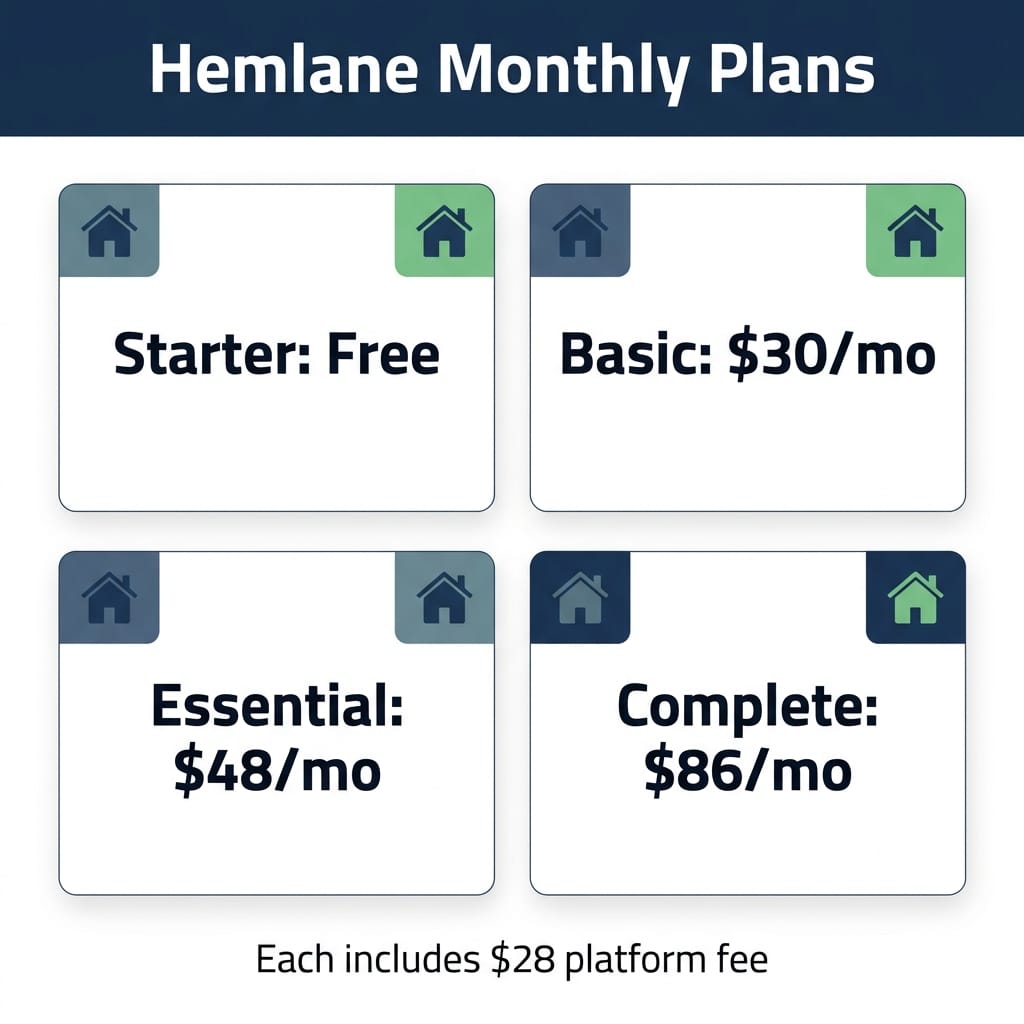
What we charge. Starter is free and includes screening, rental accounting and listing to major sites. Basic is $30/mo and adds lease tracking, document storage, rent collection and tenant messaging. Essential is $48/mo and adds a dedicated repair coordinator, 24/7 emergency support and state-specific lease documents. Complete is $86/mo and adds a property management assistant, vetted repair network access and VIP support. Each price includes a $28 platform fee. Pricing is per unit, monthly, after a 14-day trial, with discounts for annual billing. Partner agents who offer property management through Hemlane list $60/month for the first rental and $30/month for each additional rental, billed annually.
When a traditional manager is the better call. Be honest with yourself here. If approving a repair or picking a tenant feels like a burden, not control, hand it off. The same goes for a large building that needs staff on site every day. Full service is the norm at that size. In the same 2021 survey, 84 percent of properties with 150 or more units were managed professionally, against about 22 percent of small rentals. Hemlane is a technology company, not a property management firm. We don't make decisions for owners. If you want someone who does, hire a manager. Ask hard questions first.
Ask any option these questions:
- What do I pay beyond the monthly fee, including renewal, setup and termination?
- Do you mark up repairs, and by how much?
- Who keeps the late fees?
- How fast does rent reach my account, and who pays the transfer fees?
- Who picks up at 2 AM, and how fast do they dispatch?
- Which decisions need my approval?
- Can I see the books whenever I want?
- What does it take to leave?
The hybrid model has a record. Hemlane holds 4.8-star user reviews on Capterra, GetApp and Software Advice. We've completed 61,218 service requests, and users rate us 5 stars. Tenants get placed faster than the market: 25 vs. 33 days in California, 29 vs. 35 in Kansas, 26 vs. 47 in Texas. See how our nationwide service with local agents works.
Get started with Hemlane.
Frequently Asked Questions
Do out-of-state owners need a local contact for their rental property?
In practice, yes. Someone has to open the door for a plumber, check on the unit and answer when something breaks. Whether the law requires you to name a local contact depends on your state and city, so check those rules before you lease. Our licensed local agents handle showings, inspections, key handoffs and local-court coordination. Our repair coordination team picks up, troubleshoots and dispatches around the clock.
Do out-of-state owners pay state income tax on rental income?
Often, and it depends on the state where the rental sits. California, for example, taxes nonresidents only on rental income from property in California, because rent from California real estate counts as California-source income. Your home state may offer a credit for tax paid elsewhere. New York, for one, offers a resident credit for income sourced to and taxed by another state. Not every state works this way. This year, eight states levy no individual income tax at all, and Washington taxes only capital gains income. On your federal return, rental income and expenses go on Schedule E, Part I. Keep clean books for each property. Our accounting includes bank sync, a cash flow report and an income statement, and it connects with QuickBooks. Then have a tax professional who knows both states handle the filing.
How often should a remote owner inspect their rental property?
There's no single standard. Always document move-in and move-out. In between, set a rhythm based on the property's age, the tenant's history and what your lease allows. Check again after any major repair or storm. Write your plan into the lease, and give the entry notice your state requires. A licensed local agent can do the visit for you. Our pricing page lists inspections as a service add-on, and partner agents working through Hemlane list inspections among their services.
Distance is a logistics problem, and logistics can be solved. Software carries the admin. Local agents cover the door. You keep the decisions and the income. Get started with Hemlane.
Hemlane, Inc. is a technology company that helps you manage your long-term rental properties. Communications between you and Hemlane are protected by our Privacy Policy. Hemlane also provides access to independent licensed professionals and self-help services at your specific direction. We are not a property management firm. We cannot make any decisions on behalf of any property owners. Any content found in the Hemlane Academy is not a substitute for advice and ideas from a qualified legal source or expert. You are responsible for performing additional research to confirm you are complying with all laws applicable to your rental situation.
Sources


- Internal Revenue Service — Publication 527 (2025), Residential Rental Property | Internal Revenue Service · retrieved November 3, 2026
- Federal Trade Commission — Rental scams hit home with $65 million in reported losses | Federal Trade Commission · retrieved November 3, 2026
- U.S. Department of Housing and Urban Development — Housing Discrimination Under the Fair Housing Act | HUD.gov / U.S. Department of Housing and Urban Development (HUD) · retrieved November 3, 2026
- Federal Trade Commission — Using Consumer Reports: What Landlords Need to Know | Federal Trade Commission · retrieved October 26, 2026
- U.S. Environmental Protection Agency — Lead-Based Paint Disclosure Rule (Section 1018 of Title X) | US EPA · retrieved November 3, 2026
- U.S. Department of Housing and Urban Development — HUD Archives: HUD and Census Bureau Release Findings of 2021 Rental Housing Finance Survey · retrieved October 26, 2026
- WashingtonLawHelp.org — Deposits and damages | Washington Law Help · retrieved November 3, 2026
- Texas Property Code § 92.156 (via Public.Law) — Texas Property Code Section 92.156 – Rekeying or Change of Security Devices · retrieved November 3, 2026
- Consumer Financial Protection Bureau — CFPB Reports Highlight Problems with Tenant Background Checks | Consumer Financial Protection Bureau · retrieved November 3, 2026
- Federal Trade Commission — Rental Listing Scams | Consumer Advice · retrieved November 3, 2026
- Home365 — Property Management Fees in 2026: A Single-Family Owner's Guide · retrieved November 3, 2026
- California Franchise Tax Board — Rental | FTB.ca.gov · retrieved November 3, 2026
- California Franchise Tax Board — Part-year resident and nonresident | FTB.ca.gov · retrieved November 3, 2026
- New York State Department of Taxation and Finance — Resident Credit · retrieved November 3, 2026
- Tax Foundation — 2026 State Income Tax Rates and Brackets | Tax Foundation · retrieved November 3, 2026
Get the Latest in Real Estate & Property Management!
I consent to receiving news, emails, and related marketing communications. I have read and agree with the privacy policy.


