
Best Tenant Screening Services for Small Landlords (2026)

Editorial Staff
Content published by Hemlane is created and reviewed by members of our editorial team, including experienced technical writers and real estate professionals.
You have a vacancy. Every empty week costs you rent. And most lists of screening services are written by a vendor that ranks itself first.
This guide works differently. We're Hemlane, and we're one of the options here, so we'll say that up front. We won't crown a winner. We'll show you what to check, what the law asks of you and how to read a credit score. Then we'll match the type of service to your situation.
One applicant. One report. One call you have to stand behind. Let's make it a sound one.
What should small landlords look for in a tenant screening service?
Look for accurate data, careful record matching, clear sources for criminal and civil records, a separate rental history check, the full report behind any score, and support for your legal duties. Then ask one more thing. Does screening sit inside your leasing process, or does it land on your desk as a report you read alone?
Screening reports get things wrong more often than most owners think. The Consumer Financial Protection Bureau found renters turned down over records that belonged to someone else. It also found old records that stayed on reports, and arrest and eviction details that were never fixed. A wrong report can cost you a good tenant.
Here's the checklist we'd use.
- Accurate data. Ask how the service handles disputes and old records. You act on the report, so its errors become your problem.
- Matching beyond the name. Ask how records get tied to the applicant. Federal regulators have said matching on name alone is illegal under credit reporting law. Treat a vague answer as a red flag.
- Clear record sources. Ask where criminal and civil records come from and which states they cover. Many screening companies do little hand-checking, and bad public records slip through.
- A separate rental history check. Only a tiny share of renters have rent payments in the credit reporting system. A clean report may just mean no data. Call past rental references too.
- The full report, not just a score. A single tenant score makes the call feel easy. It can also hide data errors and make old or wrong records weigh more.
- Housing-only certification. Federal rules require you to certify that you'll use the report only for housing. A good service builds that step in.
- Notice support. If a report plays a part in a turn-down, you owe the applicant notice. Written notice is the safer default because it leaves proof. Look for a service that helps you send it.
- A place in a coordinated leasing process. A report is one piece. Ask who collects complete applications, who verifies identity and who moves the approved applicant to a signed lease.
That last item is where we work. With Hemlane, every prospect is ID-verified and every application arrives complete. A dedicated showing coordinator manages inquiries, schedules tours and reviews applications. Biometric checks happen before anyone steps inside your property. The decision stays yours. We make sure the file in front of you is whole. You can see screening next to listings, leases and rent collection on the Hemlane platform.
Which credit scores should landlords trust when screening tenants?
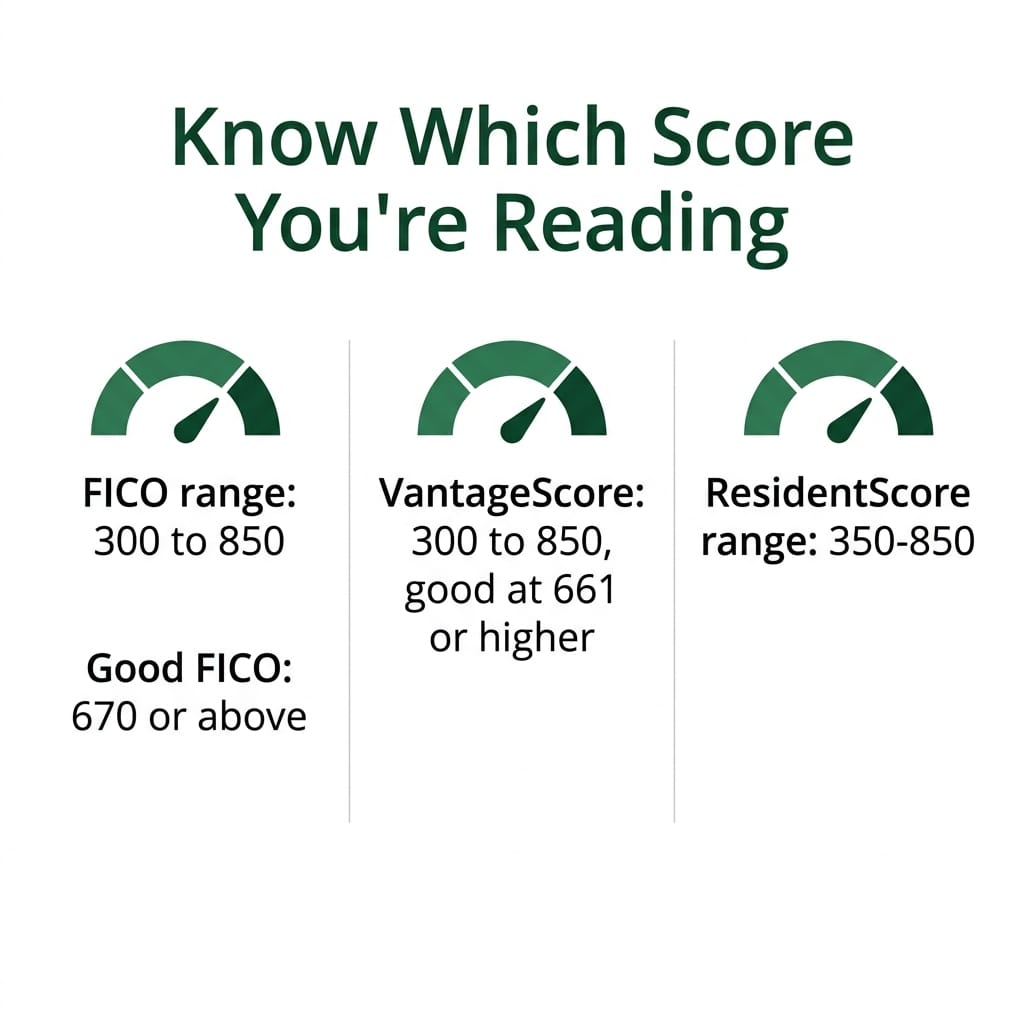
Trust a score once you know which model made it. FICO and VantageScore both run from 300 to 850 and speak to how someone handles credit. ResidentScore, from TransUnion, runs from 350 to 850 and is built to predict eviction risk. Different numbers for one applicant are normal. Read the full report behind any score.
Same applicant. Three numbers. Nobody made a mistake. A score depends on the data behind it, the formula, which bureau holds the history and even the day it was pulled. Bureaus often hold slightly different records, so scores drift.
Score model | What it's built to show | Range | What counts as good | What to check beyond the number |
|---|---|---|---|---|
FICO Score | How someone handles credit | 300 to 850 | Generally 670 or above | Whether the records are the applicant's, current and correct |
VantageScore | How someone handles credit | 300 to 850 | 661 or higher | Which bureau's data it used, and the same accuracy checks |
ResidentScore (TransUnion) | Expected eviction rate. A higher score means a lower expected rate | 350 to 850 | No published good cutoff we can point you to | The eviction and rental records behind the number |
A note on ResidentScore. TransUnion says version 3.0 is 4% more predictive than its last model and beats standard credit models by 16%. That's the company's own claim about its own product. Treat it as a vendor claim, not an independent finding.
Some applicants have no score at all. A 2015 federal study counted 26 million Americans as credit invisible. That was about one in every 10 adults with no history at a nationwide bureau. No score is not a bad score. It means you lean on other proof, like income and rental references, and you apply that same test to everyone without a score.
Can landlords charge rental applicants a screening fee?
Usually yes, with limits. Some states ban application fees outright. Some limit what you can collect before a tenancy starts. Others cap the fee. The rule depends on your state, and sometimes your city. Check before you list. Then charge every applicant the same way, every time. One state's rule is never the national rule.
Three real examples show the range.
- An outright ban. Vermont's statute, posted by the Vermont General Assembly, says an owner or agent may not charge an application fee for a residential rental. Screening there is on you.
- A short list of allowed payments. The Massachusetts Legislature limits what an owner can require at or before the start of a tenancy to a short list. A screening fee isn't on it, which in practice rules out passing it on.
- A cap. California caps applicant screening fees, and the cap gets updated. For 2026, it's $65.86.
Before you pass the fee on, confirm these five things.
- Does your state ban application fees?
- Does your state cap the fee? If so, know the number.
- Does your state limit what you can collect upfront?
- Does your screening tool let you pay instead? In a ban state, you need that.
- Is every applicant charged the same fee, at the same time, on the same terms?
The last one protects you most. Waiving the fee for one applicant and not another invites fair housing questions. This is general information, not legal advice. Confirm the rules where your rental sits.
What fair housing mistakes do small landlords make when screening tenants?


These come up most often. A blanket ban on anyone with a record. Reading a federal guidance change as a change in the law. Assuming a small building is exempt. Deciding case by case with no written rules. A second set of mistakes is about notice, not choice. Here's each one, with what to do instead.
Two different laws are at work. Fair housing law covers who you may turn down and why. HUD lists the classes the Fair Housing Act protects: race, color, national origin, religion, sex, familial status and disability. Your state or city may add more. The Fair Credit Reporting Act covers how you tell an applicant when a report shaped your decision. Items 1, 2, 3 and the last one below are fair housing. Items 4 and 5 are notice.
- A blanket no-records rule. Federal regulators warn that refusing everyone with a criminal record may violate the Fair Housing Act. Some places go further. New Jersey, San Francisco and Cook County, Illinois, which includes Chicago, have limited criminal-record screening. Instead, confirm your state and city rules before you set a criminal-history policy, and put that policy in writing.
- Reading HUD's 2025 change as a green light. A HUD memo dated September 17, 2025 withdrew several fair housing guidance documents from 2007 to 2024. That included guidance on screening with criminal records. Pulling guidance did not change the Fair Housing Act. It does not permit discrimination or inconsistent screening. Instead, keep screening the way the law has always required.
- Assuming you're too small to be covered. The federal exemption is narrow. It covers units in a building with living quarters for no more than four families, and only if the owner lives in one of them. Own a duplex across town? That exemption doesn't reach it. Your state may have its own rules too. Instead, assume fair housing law applies until you've confirmed otherwise.
- Skipping notice because the report was a minor factor. If you reject someone, raise the rent or deposit, or require a co-signer based even partly on a report, you must notify the applicant. The Federal Trade Commission says this applies even when the report wasn't the main reason. Instead, send notice every time a report touched the decision.
- Giving notice only by phone. A spoken notice is allowed. A written one is the better habit because it gives you and the applicant a record. Instead, send it in writing or by email.
- Deciding on gut feel. Common sense isn't a policy. Two owners can read the same file two ways. Instead, write your criteria before the first showing: income, credit model and cutoff, rental history, and how you treat records. Hold every applicant to that same list, in the same order, and keep notes.
We help with the front end of that habit. Every prospect is ID-verified and every application arrives complete. A dedicated showing coordinator manages inquiries, schedules tours and reviews applications. So each applicant reaches you with the same complete file. The criteria and the decision stay yours. This is information to confirm for your own state and city, not legal advice.
Which tenant screening service is best for small landlords?
We know of no independent ranking that crowns one service, so the best pick depends on you. One unit you show yourself? A self-serve report with clear sources may be enough. A few units and little time, or rentals far from home? A coordinated leasing service usually fits better. Match the service to your situation.
Here's something small owners should hear. Big corporate operators lean on automated systems that boil each applicant down to one score. Smaller owners have long done something those systems skip: they look at the whole person. That's your edge. But a lone score isn't a decision, and someone still has to read the full file and apply your criteria.
Your situation | What to prioritize | Type of service that fits |
|---|---|---|
One unit, an occasional vacancy, you show it yourself | Accurate data, clear record sources, control over who pays | A self-serve screening tool. TransUnion SmartMove, for example, lets you pay or pass the cost to the applicant |
You rent in a state that bans or limits fees | An owner-pay option, a fee within any cap, the same terms for every applicant | A tool that lets you pay, or a leasing service that handles screening as part of the process |
A few units and little time | Complete applications, ID-verified prospects, someone running tours | A coordinated leasing service, such as Hemlane |
You live in another state | Local people for showings, inspections and key handoffs | A leasing service backed by licensed local agents, such as Hemlane |
Here's what we offer, priced plainly.
- Tenant Placement, plus $100 for a digital lockbox. Covers listing and showings.
- Leasing Services. Includes rent-ready coordination, premium advertising across 15+ sites, application processing and lease signing.
- Software plans. A free Starter plan, then Basic at $30, Essential at $48 and Complete at $86 per unit per month after a 14-day trial. Add-ons cover tenant placement, inspections and eviction assistance.
The numbers behind it. Our leasing service reduces days on market by 26% and runs showings 7 days a week. We place tenants faster than the market average: 25 vs. 33 days in California, 29 vs. 35 in Kansas and 26 vs. 47 in Texas. Need the unit ready first? We can get your suite ready to rent.
Software can't hand over keys. On Hemlane, licensed local agents handle the in-person work. One example is Team Chroma Rental, serving San Francisco, Alameda and Contra Costa Counties.
We are not a property management firm, and we don't pick tenants. You call the shots. We handle the legwork, from listing to a complete, ID-verified application to a signed lease.
Get started with Hemlane
Frequently Asked Questions about tenant screening for small owners
How much does a tenant screening report cost?
It depends on the service and what the report includes, so ask before you pick one. In most cases the renter pays the application fee, not the owner. Some states set a ceiling. California's cap, covered above, is $65.86. Others ban the fee, and then the cost is yours.
Is Zillow tenant screening good?
It can be a convenient fit if you already list there. Judge it like any tool: data accuracy, record sources and access to the full report. Check who pays. A setup that relies on the applicant paying won't work where application fees are banned, like Vermont. And whatever tool you use, the notice duty is yours. If a report played even a small part in a turn-down, you must notify the applicant.
What credit score should landlords require from a renter?
There's no legal minimum and no single number every owner uses. Applicants generally have better odds at 600 to 650, and many owners want at least 600. On FICO, 670 and up is generally good. Always name the model. FICO 600 is not the same as 600 on ResidentScore, which runs 350 to 850 and predicts eviction risk. Pair the score with an income test, such as income of three to four times the rent. The right cutoff also depends on your market, the unit and the rent. We don't set it for you. Pick it, write it down and apply it to everyone.
Write your criteria. Pick the service that fits your doors. Then let a coordinated process carry the load while you keep the final call.
Manage your rentals on Hemlane
Hemlane, Inc. is a technology company that helps you manage your long-term rental properties. Communications between you and Hemlane are protected by our Privacy Policy. Hemlane also provides access to independent licensed professionals and self-help services at your specific direction. We are not a property management firm. We cannot make any decisions on behalf of any property owners. Any content found in the Hemlane Academy is not a substitute for advice and ideas from a qualified legal source or expert. You are responsible for performing additional research to confirm you are complying with all laws applicable to your rental situation.
Sources


- Consumer Financial Protection Bureau — CFPB Reports Highlight Problems with Tenant Background Checks | Consumer Financial Protection Bureau · retrieved November 3, 2026
- Vermont General Assembly (9 V.S.A. § 4456a) — 9 V.S.A. § 4456a. Residential rental application · retrieved November 3, 2026
- Massachusetts Legislature (MGL c.186 § 15B) — General Law - Part II, Title I, Chapter 186, Section 15B · retrieved November 3, 2026
- U.S. Department of Housing and Urban Development (HUD) — Fair Housing: Rights and Obligations | HUD.gov / U.S. Department of Housing and Urban Development (HUD) · retrieved November 3, 2026
- Federal Trade Commission — Using Consumer Reports: What Landlords Need to Know | Federal Trade Commission · retrieved October 26, 2026
- Bornstein Law — California Tenant Screening Fees Legal Exposure - Bornstein Law · retrieved November 3, 2026
- Consumer Financial Services Law Monitor (Troutman Pepper) — CFPB Highlights Purported "Problems With Tenant Background Checks" | Consumer Financial Services Law Monitor · retrieved November 3, 2026
- LeadingAge — HUD Withdraws Wide-Ranging Fair Housing Policies · retrieved November 3, 2026
- Navigate Affordable Housing Partners — HUD Guidance Withdrawals: What Owners/Agents Need to Know · retrieved November 3, 2026
- Cornell Law School Legal Information Institute (42 U.S.C. § 3603) — 42 U.S. Code § 3603 - Effective dates of certain prohibitions | U.S. Code | US Law | LII / Legal Information Institute · retrieved November 3, 2026
- Consumer Finance Monitor (Ballard Spahr) — CFPB highlights accuracy problems in two reports on tenant background screening reports | Consumer Finance Monitor · retrieved November 3, 2026
- Consumer Financial Protection Bureau — What you need to know: Understanding why offers for “your” credit score are not all the same | Consumer Financial Protection Bureau · retrieved November 3, 2026
- myFICO (Fair Isaac Corporation) — What is a FICO® Score and why is it important? | myFICO · retrieved November 3, 2026
- Experian — What Is a VantageScore Credit Score? · retrieved November 3, 2026
- TransUnion — Property Managers Gain Greater Predictive Power to Help Further Decrease Future Evictions · retrieved November 3, 2026
- Consumer Financial Protection Bureau — CFPB Report Finds 26 Million Consumers Are Credit Invisible | Consumer Financial Protection Bureau · retrieved November 3, 2026
- TransUnion SmartMove — Tenant Screening Service & Tenant Background Checks | TransUnion SmartMove · retrieved October 26, 2026
- Experian — What Credit Score Do You Need to Rent an Apartment? · retrieved November 3, 2026
Get the Latest in Real Estate & Property Management!
I consent to receiving news, emails, and related marketing communications. I have read and agree with the privacy policy.


