
America and the “Affordability Refugee” Crisis

Editorial Staff
Content published by Hemlane is created and reviewed by members of our editorial team, including experienced technical writers and real estate professionals.
Property Management Pulse
Housing affordability issues are putting an increasing amount of pressure on Americans, even forcing many aspiring homebuyers to leave familiar cities behind for more affordable places. Cross-market home searches topped 60% this spring, with more than 50% of would-be homebuyers across all regions expressing an interest in relocation.
Gen Zers and millennials are also leaving expensive metros like New York and Los Angeles behind, preferring to move to neighboring metros that are more affordable. While Gen Zers are making the move for better job opportunities in areas where the cost of living doesn’t eat through their bank account, millennials are going in search of more affordable homes with bigger spaces.
Americans are also saying goodbye to areas that have poor air quality, but only after taking affordability into account. So, expensive counties with poor air quality are seeing an outflow of residents, while more affordable counties are seeing an influx despite the risk of smoky air.
New home construction is stalling across several areas due to inflation driving up the prices of raw materials and construction. The rising home loan rates and economic uncertainty aren’t helping as many would-be homebuyers are opting to remain on the sidelines rather than make an offer. Experts predict that if and when housing affordability increases, the construction decline would worsen the housing shortage.
Hemlane Brief
- 6.95%: Average 30-Year Fixed-Rate Mortgage
- 2.4%: Inflation Rate
- 0.2%: Change in Rent MoM
Lack of Affordability Pushes Americans Out of Metro Cities
We may be entering an era where Americans move cities not just for better job or education opportunities, but also in search of more affordable houses. Realtor.com calls them “affordability refugees": homebuyers who are looking to buy real estate in areas beyond their local market as exorbitant home prices force them out.
This spring, Realtor.com saw cross-market home searches go up to 60% across the 100 largest U.S. metros, up from the 48% of 2019. The economic research team believes that the main driver of this is housing affordability, with would-be buyers in expensive and mid-tier metros increasingly looking outward.
What changed in the last seven years? Housing prices soared so much, especially in metro cities, turning homeownership into a distant dream for many aspiring homebuyers even in the current buyer’s market.
When broken down by region, these were the percentage of house hunters contributing to outbound home shopping traffic during the second quarter of 2026:
- West: 65%+
- South: 59.8%
- Northeast: 58.3%
- Midwest: 56.1%
As is clear from the numbers, more than half of all aspiring homebuyers across all regions were searching for more affordable options outside their local market.
Among metros, San Jose, California, took the cake for the highest number of out-of-market listing searches with 94% of shoppers looking elsewhere. That’s … a significant number. But quite valid, considering that the median asking price for a house in San Jose crosses $1.39 million.
"While San Jose's unemployment rate is below the national level, its median listing price sits 225.5% above the national average, an affordability gap steep enough to push shoppers elsewhere despite the strong labor market," says Realtor.com senior economist Jiayi Xu.
The Gen Z- and Millennial-Driven Exodus from America’s Big Metros
Keeping in theme with the previous section, an analysis by Redfin revealed that Gen Zers and millennials are putting some of America’s biggest and most expensive metros in their rear view mirrors. Their destinations? Not far-off, cheap towns, but more affordable places that are just a short hop away.
Gen Zers are saying goodbye to expensive metros like New York, Los Angeles, and Denver, embracing places like San Antonio, Washington D.C., Austin, Nashville, and Dallas: places that have a host of job opportunities for young people looking to climb up the career ladder, lively social scenes, and a more manageable cost of living.
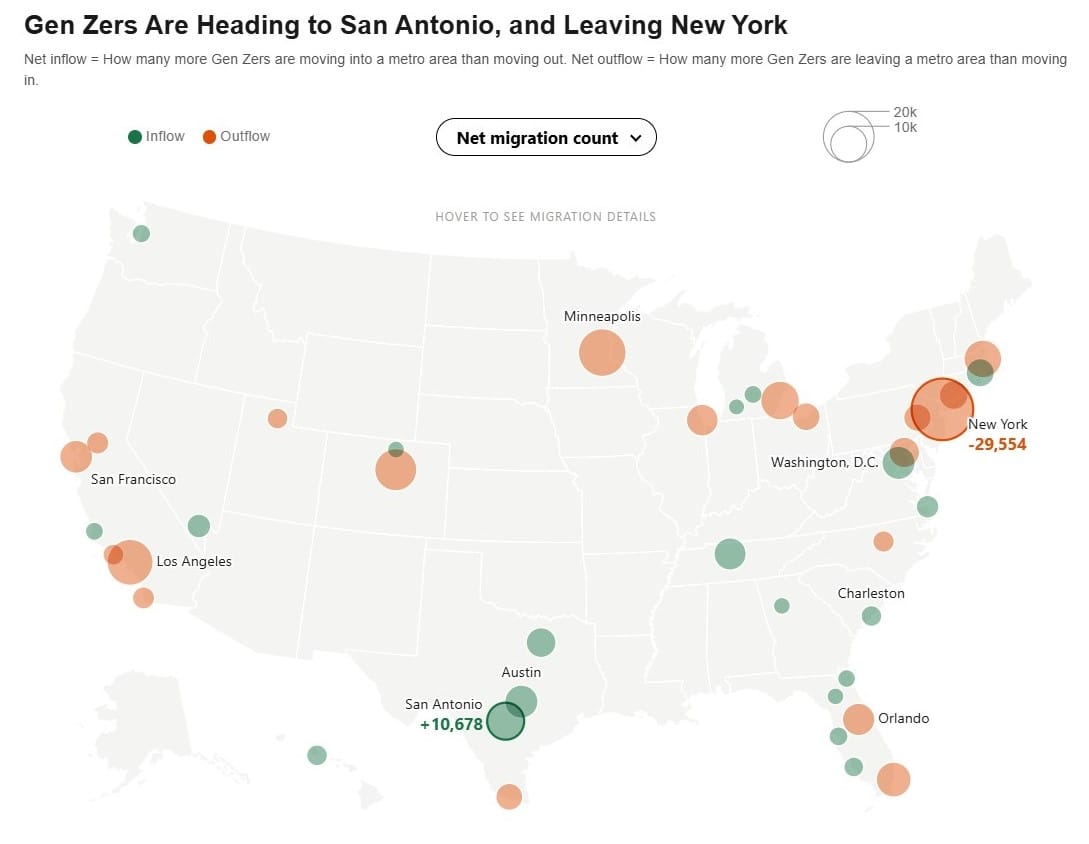
Here’s the net-inflow rate for Gen Zers across the 5 most popular destinations:
- San Antonio: +10,678
- Washington D.C.: +8,631
- Austin: +8,590
- Nashville: +8,093
- Dallas: +6,944
On the other side of the coin, here are the metros losing the most number of Gen Zers:
- New York: -29,554
- Minneapolis: -17,815
- Los Angeles: -16,465
- Denver: -13,882
- Detroit: -11,696
Millennials, though, have a different goal, although they, too, are flocking out of New York and Los Angeles. For these older millennials, though, the greatest “want” is more affordable houses with bigger spaces. So, metros like Houston and Atlanta are making their migration cut.
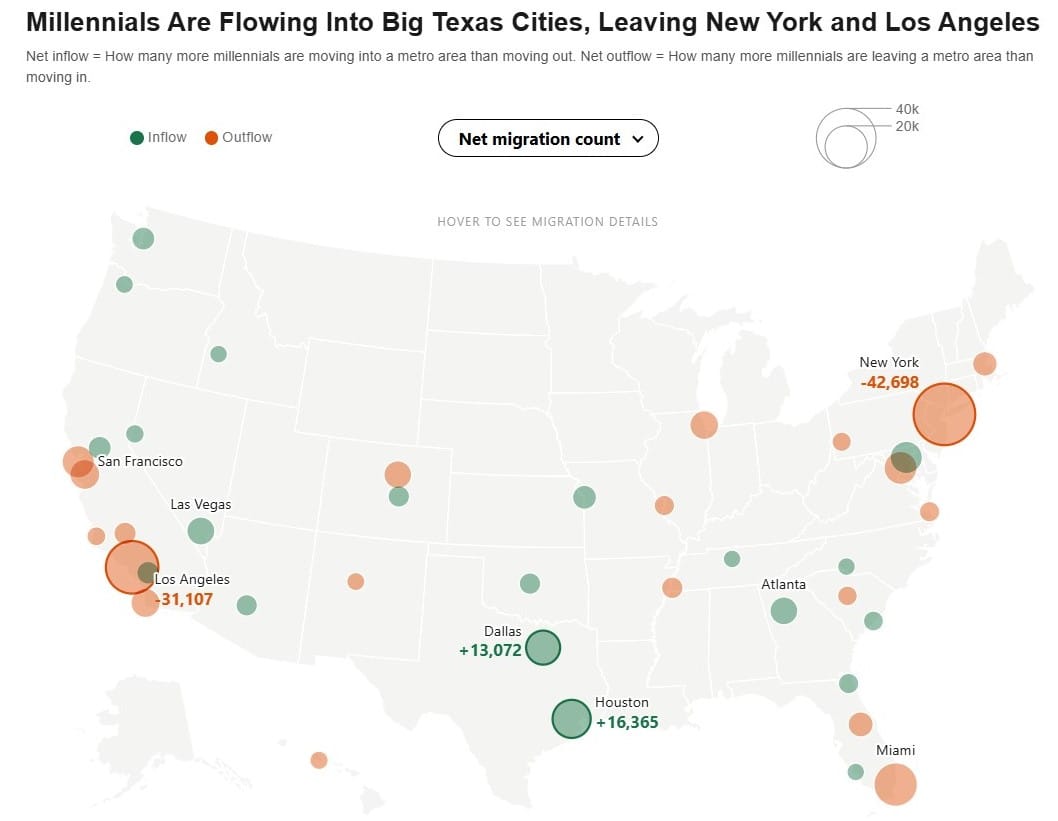


Here are the top destinations for millennial movers:
- Houston: +16,365
- Dallas: +13,072
- Baltimore: +11,724
- Las Vegas: +8,860
- Atlanta: +8,753
And here are the expensive places that are seeing a large outflow of millennials:
- New York: -42,698
- Los Angeles: -31,107
- Miami: -21,373
- Washington D.C.: -12,364
- San Francisco: -11,819
“Gen Zers are chasing opportunity, while millennials are chasing space,” says Sheharyar Bokhari, a principal economist at Redfin. “Younger adults are gravitating toward cities where they can launch careers and their social lives, while millennials are more focused on places where a paycheck stretches further and buying a home is attainable.”
Both of these generations are moving to neighboring cities rather than setting out on cross-country treks. This likely means that Americans want to stay closer to their network while also seeking more affordable homeownership.
Americans are Ditching Areas at Risk of Poor Air Quality
Affordability issues aren’t the only reason Americans are leaving familiar pastures behind; climate risk has become a major factor for migration, too.
A recent analysis by Redfin found that Americans are choosing to leave places with poor air quality behind, especially as wildfires, and all the hazardous smoke they bring, become more and more common.
With this rise in smoky air, you would think that the number of Americans leaving places with poor air quality would have increased compared to previous years. But that's not the case.
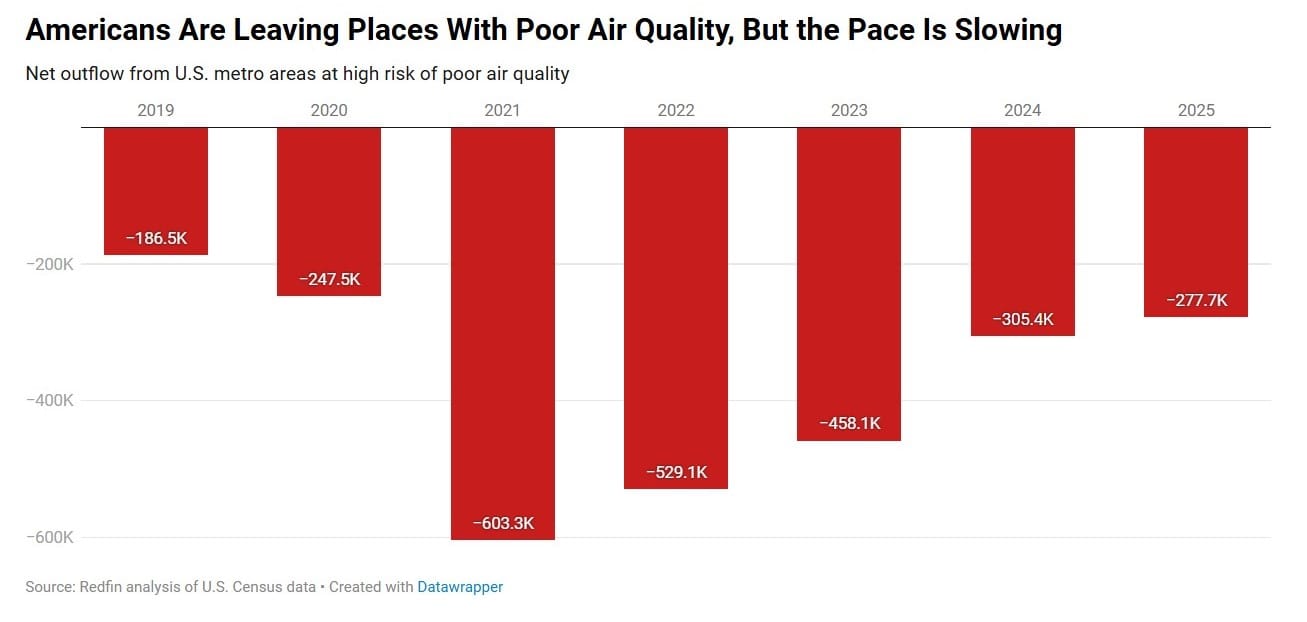
This is because air quality isn’t the only thing driving this migration. The more important, underlying cause is, once again, housing affordability.
Take a look at all the places that are losing the most residents due to bad air quality: Los Angeles County, Kings County (Brooklyn), Orange County, and King County (Seattle).
The other thing they all have in common is that they’re expensive. The average median sale price of a house across these 5 counties is a whopping $1.1 million. Buying a home here is a pipe dream for many. Combine that with the air quality, and many residents are calling it quits.
This is further proven by the fact that a lot of counties with a high risk for poor air quality are actually gaining residents, simply because they’re more affordable. This includes Ada County, Idaho (Boise), Riverside County, California, Placer County, California, Canyon County, Idaho, and Weld County, Colorado.
Despite being high-risk areas, the average median sale price of a house in these counties is around $522,000: roughly half of what we see in the most expensive counties.
Construction Slumps May Worsen Housing Shortage
The new home construction industry is facing a slump, with residential building permits now a record 19.4% below the pre-COVID trend, found a Zillow analysis. This does not bode well for the housing industry as the country continues to rage against a housing shortage.
Zillow’s data reveals something concerning: residential building permits have now declined consecutively year over year for 44 months. Here are the worst-hit areas posting the largest year over year decline:
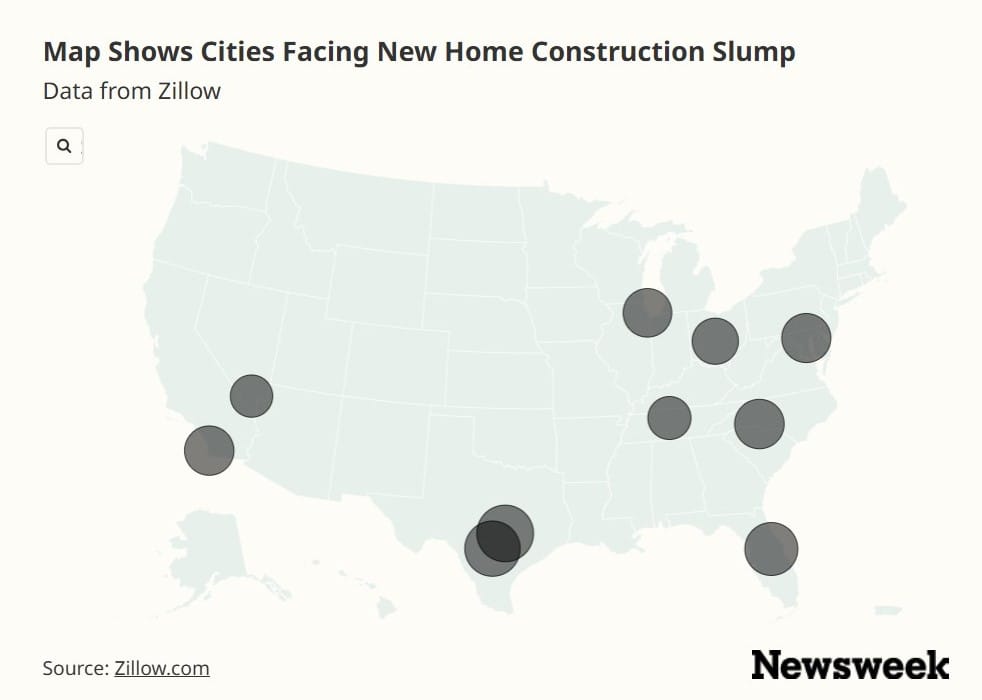
- Austin: -25.3%
- San Antonio: -24.1%
- Orlando, Charlotte, and San Diego: Around -20%
Most of this slump is concentrated in the Sun Belt markets that saw the biggest construction booms pre-pandemic. According to Bill Owens, chairman of the National Association of Home Builders, this decline in construction is mostly due to rising material and construction costs.
“Higher mortgage rates are keeping many prospective buyers on the sidelines, while rising material, gas and diesel costs are adding to the cost of construction. These challenges are making it increasingly difficult for builders to deliver homes at prices that buyers can afford,” he says.
The major problem with this slump is that, when the housing affordability pressure eases, and more buyers start pouring in, the market may not have the inventory to keep up with the demand.
How Many Showings Does it Take to Fill a Rental Vacancy?
At Hemlane, we analyzed 15,772 tours across 2,762 rental units over a period of 3.5 years to find the number of rental showings it takes to fill a vacancy. The data shows that the sweet spot lies between 2 and 5 rental showings.
Among person-led showings, vacancies were grabbed up after a median of 2 showings, with units leasing in 16 days. Self-guided tours took about 5 showings, with units leasing in 18 days.


Not only do self-guided tours help you squeeze in more listings within the same duration, they also see 2.5x the engagement. This means more interested buyers, giving you a wider pool of applicants to choose from. Additionally, self-guided tours also saved owners, agents, and managers more than 7,400 hours in person-led tours as they eliminated the need to drive to properties, show people around, and follow up.
Get the Latest in Real Estate & Property Management!
I consent to receiving news, emails, and related marketing communications. I have read and agree with the privacy policy.


