
Best Property Management Software for Small Landlords 2026

Editorial Staff
Content published by Hemlane is created and reviewed by members of our editorial team, including experienced technical writers and real estate professionals.
Shoebox receipts. A spreadsheet nobody updates. Rent checks in the mailbox. Five apps that don't talk to each other. That's where a lot of owners with one to four doors are today, and it works until it doesn't.
Most software lists online are written by a vendor that ranks itself first. This one picks by how hands-on you want to be. It puts real numbers on free plans. Then it covers what the lists skip: what to leave out under five units, how to get off paper, what to automate first and how to document move-in and move-out. You make the call. We just lay it out.
What is the best property management software for small landlords?
The best software for a small owner is the one that fits how hands-on you want to be. A one-door, do-it-yourself owner needs screening, clean books and a deposit record. A remote owner needs repair coverage and people on the ground. Pick your profile first. Then ask who pays the fees.
Most small owners run their own doors. The U.S. Department of Housing and Urban Development reported that about 22 percent of rental properties with one to four units are professionally managed. For properties with 150 or more units, it's 84 percent. So the real question isn't which brand. It's how much help you want.
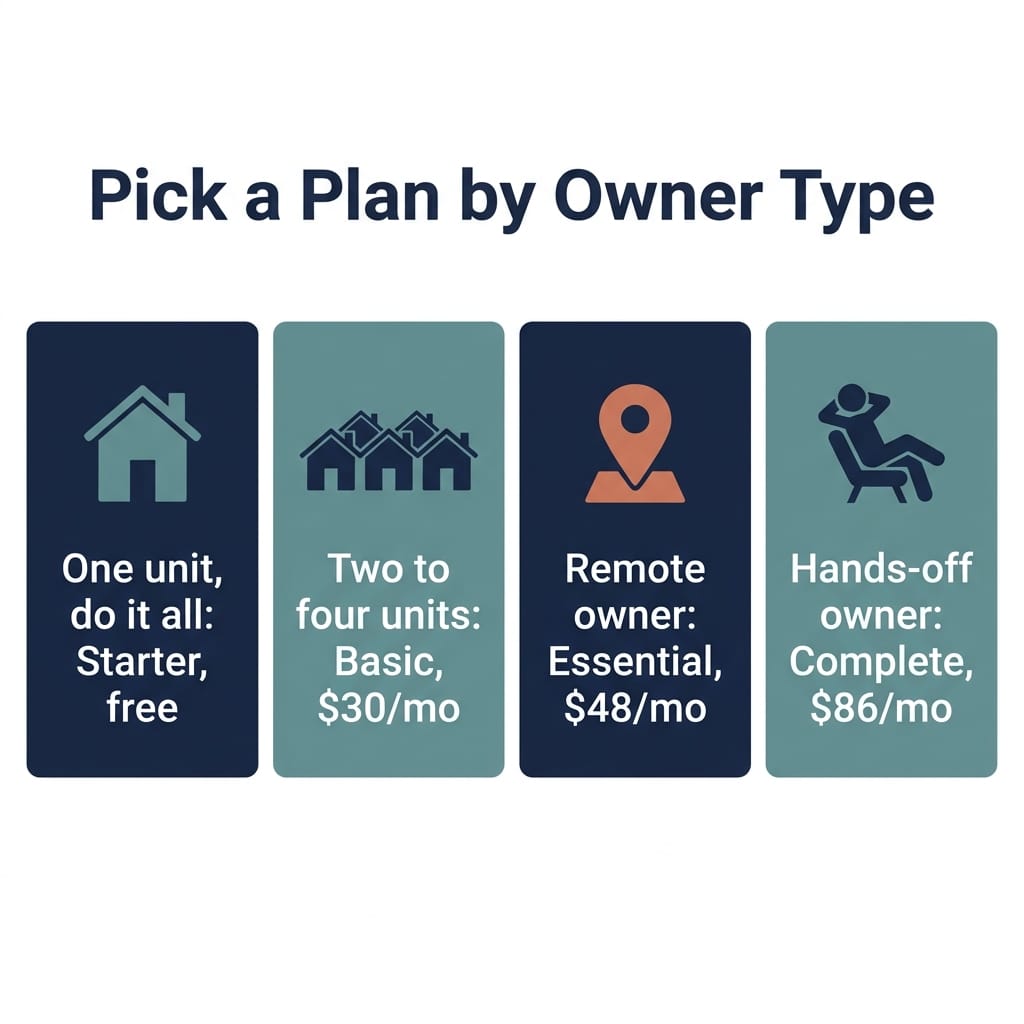
Owner profile | Must-have features | Who pays payment fees | Repairs and after-hours | In-person help | Hemlane plan that fits |
|---|---|---|---|---|---|
One unit, you do it all | Screening, listing, rental accounting, a deposit record | Paid by check? No payment fee. Online? Ask before you pick. | You take the call | You | Starter, free. Move to Basic when you want online rent. |
Two to four units, you do it all | All of the above, plus online rent, lease tracking, document storage and tenant messaging | On our plans: $0 ACH fees, and 100% of late fees go to you | You, with online repair requests | You, or an add-on when you can't get there | Basic, $30/mo (incl. $28 platform fee) |
Remote or hands-off | All of the above, plus repair coordination, 24/7 emergency support and state-specific leases | $0 ACH fees, and 100% of late fees go to you | A dedicated repair coordinator and 24/7 emergency support | Licensed local agents for showings, inspections and key handoffs | Essential, $48/mo (incl. $28 platform fee). Or Complete, $86/mo (incl. $28 platform fee). |
How free plans make money
Free isn't always free. Someone pays when rent clears. As of October 2026, TurboTenant listed tenant convenience fees of $2 per ACH payment and 3.49% for credit and debit cards. Its help center listed its Essentials tier at $149 to $349 per year, depending on portfolio size. As of August 2026, RentRedi listed $29.95 a month billed monthly, $20 a month billed semi-annually, or $12 a month billed annually.
None of that is hidden. It's just easy to miss. Ask two questions before you sign up. Who pays each time rent clears? And what does the plan you'll actually need cost per year?
Here's where we stand. Owners pay $0 ACH fees. 100% of late fees go to you. The number on the lease is the number that lands in your account.
When a lighter setup is enough
Be honest about your setup. One unit. A tenant who pays on time. You live close by. Starter may be all you need. It's free and includes tenant screening, rental accounting and listing to Apartments.com, Zillow and 7 more top websites.
At two to four doors, rent tracking and paperwork start to pile up. That's where Basic fits. It adds lease tracking, document storage, rent collection and tenant messaging.
When software alone isn't enough
Software can't let a plumber in at 2 AM. It can't hand over keys or walk a unit. If you live far away, or just want your weekends back, Essential adds a dedicated repair coordinator, 24/7 emergency support and state-specific lease documents. Complete adds a property management assistant, access to a vetted repair network and VIP support.
For in-person work, licensed local agents handle showings, inspections and key handoffs. You decide. They do the legwork. See how local agents and the platform work together.
We support over 20,000 rental properties in 4,418 cities, in all 50 states. Users rate us 4.8 stars on Capterra, GetApp and Software Advice.
Want more on 2026 costs, hidden fees and what still needs a person? Read our owner's guide to property management software costs.
What property management software features can a landlord with fewer than five units skip?
With fewer than five units, you can skip most team and big-portfolio tools. You can't skip what the law and your taxes lean on: screening with a notice step, a deposit record kept apart from your own money, and real books. The rest can wait until you grow or move away.
Skip at this size | Keep, even at one unit | Add later, as you grow or go remote |
|---|---|---|
Owner portals and owner statements. You are the owner. | Tenant screening with a written notice step. Federal rules require notice when a report shapes a no. | 24/7 repair coordination. Worth it once 2 AM calls cost you sleep. |
Team roles and permissions. Most small rentals are run by one person. | A deposit record kept apart from your own money. Some states require it. | Licensed local agents for showings, inspections and key handoffs. For when you can't be there. |
Multi-owner trust accounting. That's for managers holding other people's money. | Rental accounting with repairs and improvements kept apart. Your taxes and your sale depend on it. | A property management assistant and VIP support. For a growing portfolio. |
Self-touring hardware and smart-access gear. Built for large communities. | A signed lease and move-in condition record, stored together. It's what you compare against at move-out. | A vetted repair network. For when you don't have your own go-to plumber. |
Custom dashboards. A cash flow report and income statement cover it. | Listing to major sites. Vacant units cost money. | Online rent and autopay. For when checks start running late. |
The skip column is our judgment, not a legal rule. Two items in the keep column have law behind them.
Screening is the first. The Federal Trade Commission says that if you turn down an applicant, raise the rent or deposit, or require a co-signer based partly or completely on a consumer report, you must tell the applicant or tenant. The notice can be written, electronic or oral.
Deposits are the second. In New York, owners of any size must treat deposits as trust funds that belong to tenants. They can't mix them with their own money. That's one state's rule. Check yours.
Here's how the keep column lines up with our plans. Starter is free and covers tenant screening (national credit, criminal, eviction and income reporting) and full rental accounting with bank sync, a cash flow report and an income statement. Basic adds lease tracking, document storage, rent collection and tenant messaging. For most owners under five units, Basic covers the software side of the keep column with no extras. Your notice letters and your deposit account are still yours to set up. Compare every plan and add-on on our pricing page.
Get started with Hemlane
How should a small landlord switch from paper records to property management software?
Gather everything first. Then set up in order: properties, tenants, opening balances, categories, and the rent switch on a clean cycle. Keep your paper until the new system proves it holds your records correctly. Keeping books in software is an accepted way to keep tax records, and it's held to the same rules as paper.
No shame in paper. It's where most owners start. The move goes smoothly when you take it one step at a time.
- Gather everything before you open the software. Leases. Tenant names, phone numbers and emails. Deposit records: how much, when you took it and where you hold it. Your rent ledger. Receipts for repairs and improvements. Closing papers from your purchase. One box or one folder.
- Set up properties, units and tenants. Enter each property, then each unit, then each tenant with lease dates. Store tenant records and documents in one place, starting with the signed lease.
- Enter opening balances, with deposits as money you owe. A deposit you plan to return isn't income. The IRS says not to count a security deposit as income when you receive it if you plan to return it at the end of the lease. Enter it as a liability. Your income numbers start clean.
- Set up categories, with repairs and improvements apart. A faucet repair and a new roof are not the same on your taxes. Keep repair costs and improvement costs separate from day one. You'll need the improvement costs when you sell or depreciate the property.
- Switch rent on a clean cycle. Pick a due date and tell tenants in writing ahead of it. Give them the date, how to pay and who to ask. Tenants can pay by ACH, card or Cash App, with autopay available. Rent is deposited to your bank account in 2 to 3 business days. Keep accepting checks until the switch date so no payment falls through the gap.
- Scan your paper, but don't shred it yet. The IRS says electronic records must meet the same rules as paper ones. It also says paper originals may be destroyed only after the electronic system has been tested to reproduce them correctly, with steps in place to keep it that way. Scan. File. Keep the paper for now.
- Know what to keep and for how long. In general, keep tax records for three years from the date you filed the return. Records on the property itself, like the purchase and every improvement, stay until you sell. You need them to figure your gain or loss. Some states add their own rules. Massachusetts, for one, requires owners who took a deposit to keep each unit's condition record for two years after the tenancy ends.
- Check the first month against paper. When the first rent cycle closes, match the software ledger to your bank statement and your old paper ledger. Fix any gap now, not at tax time. Once the books balance, the same ledger gives you cash flow statements, income statements, rent rolls, tenant ledgers and tax-ready Schedule E reports. See what the reports look like. Use QuickBooks? Hemlane integrates with it.


This is a setup order, not tax advice. For your own return, talk to a qualified tax professional.
Which tasks should a small landlord automate first with property management software?
Automate rent collection first. Then late fees set to your lease and state law, then your screening notice step, repair intake, renewal reminders and, last, your books. The order follows three things: how often the task comes up, what it costs when you miss it and how much legal risk it carries.
- Rent collection, with reminders and autopay. It happens every month, and a missed payment is your income. Turn on online rent, payment reminders and autopay first. Owners pay $0 ACH fees. Set up rent collection and late fees.
- Late fees, set to your lease and your state. Automatic late fees save you an awkward call. But you set them, and the law sets the limits. In Texas, for a unit in a building with four or fewer units, a late fee counts as reasonable if it's no more than 12 percent of the rent for that period. Texas also requires notice of the fee in a written lease, and the rent must be unpaid two full days after it was due. That's one state. Check your own state and your lease before you turn this on. When a late fee is paid, 100% of it goes to you.
- Screening and the notice step. Screening doesn't happen monthly, but a slip here carries real legal risk. If a report played even a small part in turning someone down, you must notify them. Oral notice is allowed. Written notice is the better practice and benefits both sides. Keep a written template ready and use it every time.
- Repair intake. Texts. Voicemails. A note on the fridge. Tenants send requests through an online portal instead. You assign work orders and track status in one place. On Essential and Complete, 24/7 Repair Coordination picks up after-hours and weekend requests. We've completed 61,218 service requests. See how repair intake works.
- Lease renewal reminders. Renewals sneak up. Set reminders well before a lease ends. That gives you time to decide on rent and terms, then send a state-specific lease for e-signature. Set up renewals and leases.
- Bookkeeping categories and reports. Last, because it only pays off once rent and repairs flow in. With categories set, the same ledger produces a tax-ready Schedule E report without manual exports.
How should small landlords document move-in and move-out inspections?
Write down the unit's condition room by room on move-in day. Take dated photos. Have you and the tenant both sign. Give the tenant a copy and store it with the lease. At move-out, walk the same list and compare. Before any of it, check your state's form and deadline rules.
Deposit disputes are where small owners lose money and sleep. A clean move-in record means you don't have to guess later.
State rules vary, and these are only examples. In Washington, an owner who collects a deposit must give the tenant a signed, dated written lease and condition checklist, plus copies. Arizona requires a signed lease copy, a move-in form for listing existing damage and written notice that the tenant may attend the move-out inspection. The Commonwealth of Massachusetts requires a separate written statement of the unit's condition when the deposit is received or within ten days after the tenancy starts, whichever is later.
Move-in
- Check your state's form and deadline rules first. Some states set the form, the signatures and the timing.
- Walk room by room with a checklist. Note cleanliness, walls (paint and wallpaper), carpets and other flooring, furniture, appliances and fixtures. List every key you hand over. Write down existing damage, however small.
- Take dated photos or video. Shoot each room wide, then close up on any damage. Make sure the date is on every file.
- Both of you sign and date it. Your signature and the tenant's, on the same record.
- Give the tenant a copy. Keep proof that you did.
- Store it with the lease. Keep the checklist and photos in the tenant file. On Basic, document storage keeps condition records with the lease and tenant records. Keep it as long as your state requires. In Massachusetts, that's two years after the tenancy ends.
Can't be there in person? Licensed local agents handle inspections and key handoffs. Inspections are listed among the service add-ons on our pricing page.
Move-out
- Give notice of the inspection where your state requires it. In Arizona, for example, the tenant is told at move-in that they may be present at move-out.
- Walk the same checklist in the same order. Same rooms. Same items.
- Shoot the same angles. Side-by-side photos make changes easy to see.
- Compare against the move-in record. Anything on the move-in list isn't new. Ordinary wear isn't damage. In Washington, for example, deposits can't be kept for wear from ordinary use.
- Write down what changed, with photos. Then follow your state's deposit rules and deadlines.
This guide informs. It isn't legal advice, and no record guarantees how a dispute ends. Check your state's rules before move-in day.
Pick by how hands-on you want to be. Get off paper in order. Automate rent first. Keep a signed record for every unit. Every decision stays yours. The software and our team carry the load.
Manage your rentals on Hemlane
Frequently Asked Questions
Are tenant-led move-in inspections legally defensible for small landlords?
They can be, when the record is complete, both of you sign it and it follows your state's rules. It's not a flat yes. In Massachusetts, an owner can't deduct for damage listed on a separate list the tenant submits and the owner signs. In Washington, when the tenant fills out the checklist, the owner must sign it and give back a copy of the final version.
So a tenant's list counts once you sign it. Check it against your own photos before you do. If you can't get there, a licensed local agent can walk the unit for you. This is general information, not legal advice.
Do small landlords need a separate bank account for each rental property?
No federal rule says you need one account per property. On the tax side, what matters is accurate records, like keeping repair and improvement costs apart. Keeping rental money away from personal money is the baseline. Small business guidance says fully separating business and personal funds takes two different bank accounts.
Deposits are where states get strict. New York says owners of any size must treat deposits as trust funds and not mix them with their own money. Massachusetts requires deposits to be held in a separate, interest-bearing account in a Massachusetts bank, beyond the reach of the owner's creditors. Florida lists a separate non-interest-bearing account in a Florida financial institution as one option. Those are three states, not a national rule.
Our rental accounting syncs with your bank, and reports can cover one property, an entity or your whole portfolio. We don't hold your deposits. How many accounts you open is your call, based on your state's rules and your tax pro's advice.
What is the 80/20 rule for rental property?
It's the Pareto principle: roughly 80% of results come from about 20% of the inputs or effort. It's an observation, not a law, a lending rule or a financial requirement. RB Legacy Property Management, a property management company, applies it to rental maintenance on its blog. For a small owner, it points the same way as this guide. Get the few things that protect your income right first: rent, screening, deposits and repairs.
Hemlane, Inc. is a technology company that helps you manage your long-term rental properties. Communications between you and Hemlane are protected by our Privacy Policy. Hemlane also provides access to independent licensed professionals and self-help services at your specific direction. We are not a property management firm. We cannot make any decisions on behalf of any property owners. Any content found in the Hemlane Academy is not a substitute for advice and ideas from a qualified legal source or expert. You are responsible for performing additional research to confirm you are complying with all laws applicable to your rental situation.
Sources


- U.S. Department of Housing and Urban Development (2021 Rental Housing Finance Survey release) — HUD Archives: HUD and Census Bureau Release Findings of 2021 Rental Housing Finance Survey · retrieved October 26, 2026
- Federal Trade Commission — Using Consumer Reports: What Landlords Need to Know | Federal Trade Commission · retrieved October 26, 2026
- Internal Revenue Service (Publication 527) — Publication 527 (2025), Residential Rental Property | Internal Revenue Service · retrieved November 3, 2026
- Internal Revenue Service (Publication 583) — Publication 583 (12/2024), Starting a Business and Keeping Records | Internal Revenue Service · retrieved November 3, 2026
- Commonwealth of Massachusetts (Mass.gov) — Mass. General Laws c.186 § 15B | Mass.gov · retrieved November 3, 2026
- Internal Revenue Service — Good recordkeeping year-round helps taxpayers avoid tax time frustration | Internal Revenue Service · retrieved November 3, 2026
- WashingtonLawHelp.org (Northwest Justice Project) — Deposits and damages | Washington Law Help · retrieved November 3, 2026
- Arizona State Legislature (ARS 33-1321) — 33-1321 - Security deposits · retrieved November 3, 2026
- TurboTenant — Collect Rent Online - Free For Landlords · retrieved November 3, 2026
- TurboTenant Help Center — Is There a Cost to Sign Up for TurboTenant? | Welcome to Our Help Center! · retrieved October 26, 2026
- RentRedi — Is RentRedi Worth It? Pricing, Features & ROI in 2026 · retrieved November 3, 2026
- New York State Office of the Attorney General — Residential Tenants’ Rights Guide | New York Attorney General · retrieved November 3, 2026
- Texas Public Law (Tex. Prop. Code § 92.019) — Texas Property Code Section 92.019 – Late Payment of Rent; Fees · retrieved November 3, 2026
- The Florida Senate (2025 Florida Statutes § 83.49) — Chapter 83 Section 49 - 2025 Florida Statutes - The Florida Senate · retrieved November 3, 2026
- U.S. Small Business Administration (blog contributor) — 5 Ways to Separate Your Personal and Business Finances - Small Business Administration · retrieved November 3, 2026
- Corporate Finance Institute — Pareto Principle - Overview, Application, Use, Benefit · retrieved November 3, 2026
- University of York — The Pareto Principle - Study & revision: a practical guide - Subject Guides at University of York · retrieved November 3, 2026
- RB Legacy Property Management — The 80/20 Rule of Rental Property Maintenance · retrieved November 3, 2026
Get the Latest in Real Estate & Property Management!
I consent to receiving news, emails, and related marketing communications. I have read and agree with the privacy policy.


