
Mapping Where Rent Delinquency Is Rising Fastest Across the U.S.

Editorial Staff
Content published by Hemlane is created and reviewed by members of our editorial team, including experienced technical writers and real estate professionals.
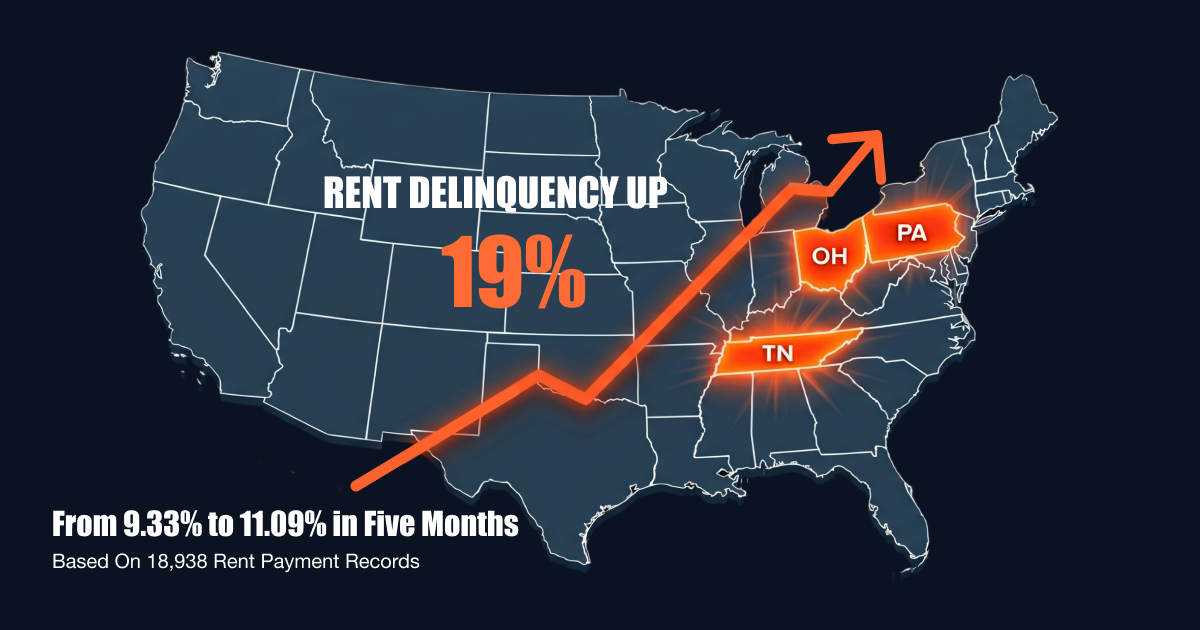
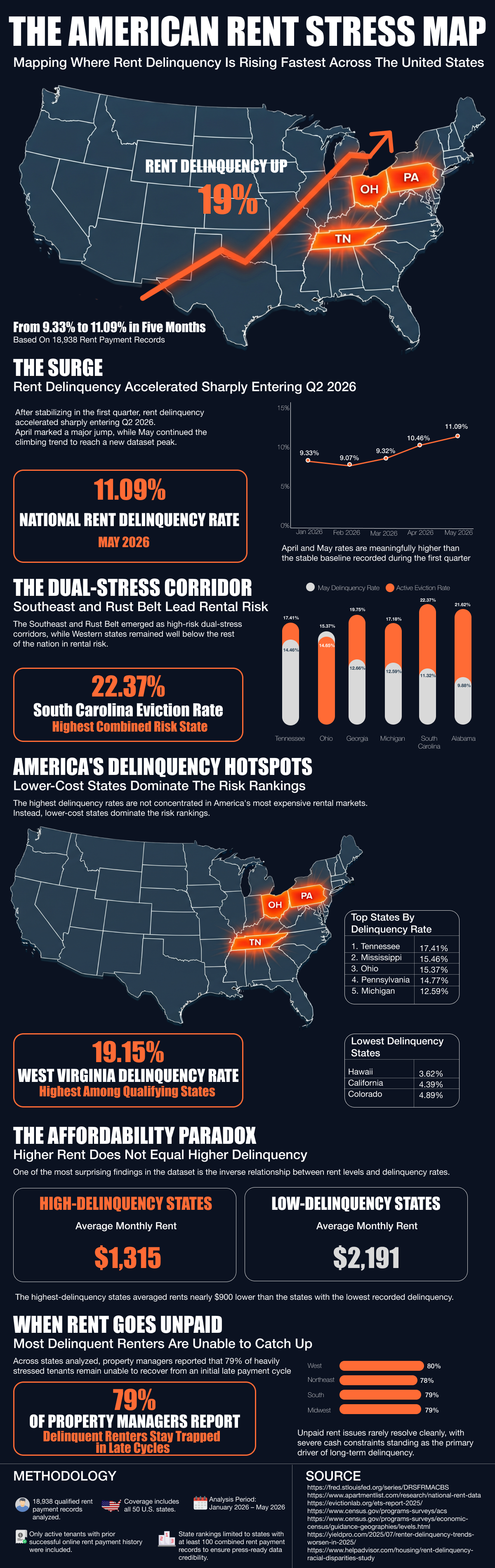
Following a period of relative stability during the first quarter, a sudden acceleration in missed rent payments has reshaped the housing market as the second quarter of 2026 progresses. Between January and May 2026, the national rent delinquency rate climbed from 9.33% to an unexpected peak of 11.09% as tenants fell behind on payments.
A new analysis of 18,938 qualified rent payment records reveals a shifting landscape of tenant financial health. While expensive coastal markets have historically dominated affordability discussions, the latest data reveal a stark reality: the sharpest concentrations of rent delinquency are in lower-cost states across the Southeast and the Rust Belt.
Key takeaways
- National Rent Delinquency Hit 11.09% in May 2026, marking a clear departure from the stable baseline observed throughout the first quarter.
- The Q2 Inflection was Rapid, with April (+1.14 percentage points) and May (+0.63 percentage points) showcasing a sharp acceleration that outpaced early Q1 metrics.
- The Dual-Stress Corridor of the Southeast and Rust Belt represents the nation’s highest combined housing pressure, where high state delinquency rates directly intersect with elevated active court evictions.
- Tennessee (17.41%), Mississippi (15.46%), Ohio (15.37%), and Pennsylvania (14.77%) rank as the highest-delinquency states with press-ready sample sizes, while West Virginia recorded the highest overall rate at 19.15%.
- 79% of Heavily Stressed Tenants stay trapped in a late payment cycle once an initial default occurs, making recovery incredibly rare due to severe underlying cash constraints.
The Q2 2026 acceleration in missed payments
After stabilizing throughout the first quarter of the year, rent delinquency rates accelerated drastically in the spring of 2026. In February 2026, the national rate sat at a stable low of 9.07%, before ticking up slightly to 9.32% in March.
However, April marked a significant inflection point, rising by a full percentage point to 10.46% before climbing to its 11.09% peak in May. This rapid deterioration in payment performance indicates that tenant financial buffers may have been exhausted, leading to sudden defaults rather than a slow, predictable decline. The fact that delinquency increases outpaced steady portfolio growth during this exact timeframe underscores a genuine tightening of household budgets nationwide.
The affordability paradox
Conventional wisdom often assumes that the most expensive rental markets carry the highest risk of non-payment. However, the data reveal an affordability paradox: higher market rents do not translate to higher delinquency rates.
The qualifying states with the highest delinquency rates feature a combined average monthly rent of just $1,315. In stark contrast, the lowest-delinquency states—which include Hawaii, Colorado, and California—boast a significantly higher average monthly rent of $2,191. This nearly $900 gap suggests that while absolute housing costs are heavier in expensive coastal states, the underlying tenant base in those regions possesses deeper financial reserves, higher average incomes, or more consistent employment buffers to maintain their monthly housing obligations.


Understanding the dual-stress corridor and tenant behavior
Geography plays a defining role in tracking rental risk. A high-intensity "Dual-Stress Corridor" has materialized across the Southeast and the Rust Belt, driven by a volatile mix of high delinquency and active legal proceedings. In states like South Carolina and Alabama, delinquency intersects with active eviction filing rates of 22.37% and 21.62%, respectively. Meanwhile, Georgia, Michigan, Ohio, and Tennessee are seeing double-digit rent defaults coupled with aggressive court actions.
Furthermore, data shows that once rent goes unpaid, it rarely resolves cleanly. Across the states analyzed, property managers reported that 79% of heavily stressed tenants remain entirely unable to recover from an initial late payment cycle. This compounding trend reveals that delinquency is rarely a temporary oversight; rather, severe underlying household cash constraints and job disruptions mean that when a tenant falls behind, the impact on property cash flows is immediate, long-lasting, and highly structural.
Looking ahead: Navigating the new rental landscape
The sharp rise in missed rent payments through the first half of 2026 signals a critical shift in the U.S. rental market. Because the steepest indicators are appearing in traditionally lower-cost housing markets, property managers and housing professionals must actively rethink their standard risk assessments.
The data proves that historically affordable baseline prices are no longer a guarantee against payment defaults. Furthermore, the persistent nature of these missed payment cycles indicates that property operators must prioritize early intervention, clear communication, and modern rent-mitigation strategies before a tenant becomes permanently trapped in an unrecoverable late cycle.
How to read the rent stress map
The accompanying infographic visualizes the shifting severity of rent delinquency across the United States. Darker, high-contrast regions—specifically hotspots like West Virginia, Tennessee, Ohio, and Pennsylvania—indicate areas with the highest percentage of missed rent payments.
The corresponding trend line isolates the sharp acceleration in defaults entering the second quarter of 2026, contrasting the stable Q1 base with the sudden jumps seen in April and May. Finally, the Dual-Stress scatter metrics highlight the states caught in a simultaneous squeeze of high delinquency and active eviction filings.
Methodology
This analysis is based on 18,938 qualified rent payment records spanning all 50 U.S. states, extracted from the Hemlane production database. The analysis period covers January 2026 through May 2026. To ensure a verified and stable baseline, the dataset includes only active tenant groups with a documented history of at least one successful online rent payment prior to the reference period, and excludes subsidized housing vouchers and specific institutional multi-account portfolios that skew localized data. State-level rankings are strictly limited to states generating at least 100 combined records to ensure press-ready data credibility.


Sources
- https://fred.stlouisfed.org/series/DRSFRMACBS
- https://www.census.gov/programs-surveys/acs
- https://www.census.gov/programs-surveys/economic-census/guidance-geographies/levels.html
- https://www.apartmentlist.com/research/national-rent-data
- https://evictionlab.org/ets-report-2025/
- https://yieldpro.com/2025/07/renter-delinquency-trends-worsen-in-2025/
- https://www.helpadvisor.com/housing/rent-delinquency-racial-disparities-study
Get the Latest in Real Estate & Property Management!
I consent to receiving news, emails, and related marketing communications. I have read and agree with the privacy policy.


