
Rental Property Management: A Practical Guide for Owners

Editorial Staff
Content published by Hemlane is created and reviewed by members of our editorial team, including experienced technical writers and real estate professionals.
Showings. Screening. Late rent. The 2 AM leak. When you self-manage, all of it lands on your phone.
You don't need a big team to run a rental well. You need a map of the work, a way to price the unit, and a clear view of your options. This guide gives you all three. It closes with three quick rules of thumb that owners use to screen deals. You stay the one who decides.
What does a landlord have to handle when self-managing a rental property?
You handle the whole tenancy. That means marketing, showings, screening, the lease and its disclosures, move-in, rent, repairs, renewals and move-out. Some of it is federal law. Some of it changes by state. Much of it can run from a laptop anywhere. A few jobs need a person on site or someone awake at 2 AM.
Here is the tenancy in order, with who can actually do each job.
Stage | Your tasks | How often | Who can do it |
|---|---|---|---|
Marketing and listing | Photos, description, rent price, posting to rental sites | Each vacancy | Software, from anywhere |
Showings | Booking tours, opening the door, answering questions | Each vacancy | A local person |
Screening | Applications, consumer reports, applying the same criteria to everyone | Each applicant, and at renewal if you re-screen | Software, from anywhere |
Lease and required disclosures | A lease that fits your state, e-signatures, lead disclosure for most homes built before 1978 | Each new tenant | Software, from anywhere |
Move-in | Walkthrough, condition photos, key handoff, deposit | Each new tenant | A local person |
Rent collection and accounting | Collecting rent, tracking late fees, logging expenses, keeping records | Monthly | Software, from anywhere |
Maintenance and emergencies | Taking requests, troubleshooting, dispatching vendors, paying invoices | Ongoing, often after hours | Local vendors plus after-hours coverage |
Renewals | Deciding terms and rent, sending notice, signing | Each lease term | Software, from anywhere |
Move-out and deposit | Inspection, damage records, returning the deposit under your state's rules | Each turnover | A local person |
Two of these stages carry federal duties that catch new owners off guard.
Lead disclosure. The U.S. Environmental Protection Agency says the lead rules cover most private housing built before 1978. Before the tenant signs, you give them lead information. You also disclose anything you know about lead paint or lead hazards in the home.
Screening. The Federal Trade Commission explains that owners may pull consumer reports on applicants and on tenants who renew. When you pull one, you certify to the report company that you will use it only for housing. Our screening covers national credit, criminal, eviction and income reporting. It hands you the facts. How you use them is still your call, and your duty.
Deposits, notices and evictions follow state law. There is no single national rule. Treat this table as a map of the work, not a full legal checklist for your state.
Most of the desk work can live in one place. Our lease management tools create state-specific leases, collect e-signatures, send renewal reminders up to 90 days before a lease ends, and keep tenant records together. Rent collection carries $0 ACH fees. Rental accounting includes bank sync, a cash flow report and an income statement. You can see rent, screening and repairs under one Hemlane login, with local support while you watch it all from anywhere.
How should a landlord set the rent on a rental property?
Price the unit against the rentals your tenant would actually tour. Gather nearby comparables, adjust for what is different about yours, set a launch price, then let early inquiries tell you if you got it right. Before you raise rent later, check your state's cap and, if you take vouchers, the payment standard.
You can run this routine in an afternoon.
- Gather comparables. Pull current listings near you with the same bedrooms and baths and a similar type of home. Units that rented recently tell you more than units still sitting.
- Adjust for differences. Compare size, condition, utilities included, pet policy, lease length and appliances. Move your number up or down for each real difference.
- Set a launch price. Pick a number inside the range your closest comparables set. Not the number you hope for.
- List widely. Our free Starter plan advertises to Apartments.com, Zillow and 7 more top websites.
- Read the response. A flood of inquiries and quick applications can mean you priced low. Silence can mean you priced high or the listing is weak. Adjust in small steps. Every empty week costs you rent.
- Revisit at renewal. Check the market again. Then check the legal limits below before you send any notice.
Which way each feature or term usually pushes rent:
Feature or term | Usual direction |
|---|---|
More space or an extra bedroom | Up |
Updated kitchen and good condition | Up |
Utilities included | Up |
In-unit washer and dryer | Up |
Pets allowed | Up, with a wider pool of renters |
Shorter or month-to-month lease | Often up, to cover turnover |
Dated finishes or deferred repairs | Down |
No parking where renters expect it | Down |
Know the hard limits. If you accept housing vouchers, federal rules set the payment standard between 90% and 110% of the area's published Fair Market Rent for the unit size. That caps what the voucher covers, so check with your local housing agency.
Some states cap increases too. The California Department of Justice says the Tenant Protection Act caps yearly increases at 5% plus the change in the cost of living, up to 10%. The Oregon Department of Administrative Services set Oregon's maximum increase for 2026 at 9.5%. These are two states' rules, not a national one. Check the law where your rental sits.
When the unit goes to market. Weekend showings eat your time. Our tenant placement and leasing services take them off your plate. Tenant Placement has its own fee, plus an added fee for a digital lockbox. Leasing Services is the fuller tier and adds rent-ready coordination, premium advertising across 15+ sites, application processing and lease signing. Showings run 7 days a week, and we cut days on market by 26%. In California, we place tenants in 25 average days versus 33 for the state market. Owners there can see local market and rent-law context.
What are the biggest mistakes new landlords make managing a rental property?
Most costly mistakes come from missing process, not bad intent. The big ones are uneven screening, skipped notices, blanket bans, trusting a report blindly, generic leases, mispriced rent, loose records and the wrong insurance. Each one is fixable with a written routine and the right tools. Here is what happens and how to avoid each.
This is not legal advice or a full list of your duties. It is the short list we see trip owners up.
- Screening applicants differently. What happens: you can't explain why one person got the unit and another didn't, and that is a fair-housing risk. How to avoid it: write your criteria before you list, then apply them to every applicant in the same order.
- Skipping the adverse-action notice. What happens: under federal rules, if a consumer report played any part in turning someone down, raising their rent or deposit, or requiring a co-signer, you owe them a notice. It can be written, electronic or spoken. How to avoid it: make the notice a fixed step in every denial or added condition.
- Using a blanket criminal-record ban. What happens: federal guidance warns that refusing anyone with a criminal record may violate the Fair Housing Act. How to avoid it: use written, case-by-case criteria, and check your state's rules with a qualified expert.
- Trusting a report without checking it. What happens: reports get things wrong. The Consumer Financial Protection Bureau found renters filed more than 16,000 complaints about wrong information on their reports, and 4,500 more about trouble getting errors fixed. How to avoid it: when something doesn't fit, ask the applicant and verify it. Our screening covers national credit, criminal, eviction and income reporting. Treat it as a starting point, not the final word.
- Signing an informal or generic lease. What happens: a template from another state can miss terms your state requires. How to avoid it: use a lease written for your state. State-specific lease documents come with our Essential plan.
- Mispricing the rent. What happens: too high and the unit sits empty. Too low and you leave money on the table for a full lease term. How to avoid it: follow the pricing steps above and read the early response.
- Keeping loose records. What happens: receipts get lost, tax time hurts, and deposit disputes turn into your word against theirs. How to avoid it: keep every dollar and photo in one system. Our rental accounting includes bank sync, a cash flow report and an income statement.
- Carrying the wrong insurance. What happens: a homeowners policy may not fit a home you rent out. If you rent out the entire home, you generally need landlord insurance. How to avoid it: call your insurance agent before the tenant moves in.
Is hiring rental property management worth it for a landlord?
It depends on what you value and what you can carry. You have three options, not two. Hand the property to a full-service manager, do it all yourself, or keep every decision and add software plus local help. Full-service buys back time for a share of the rent. Self-managing keeps the money but keeps you on call.
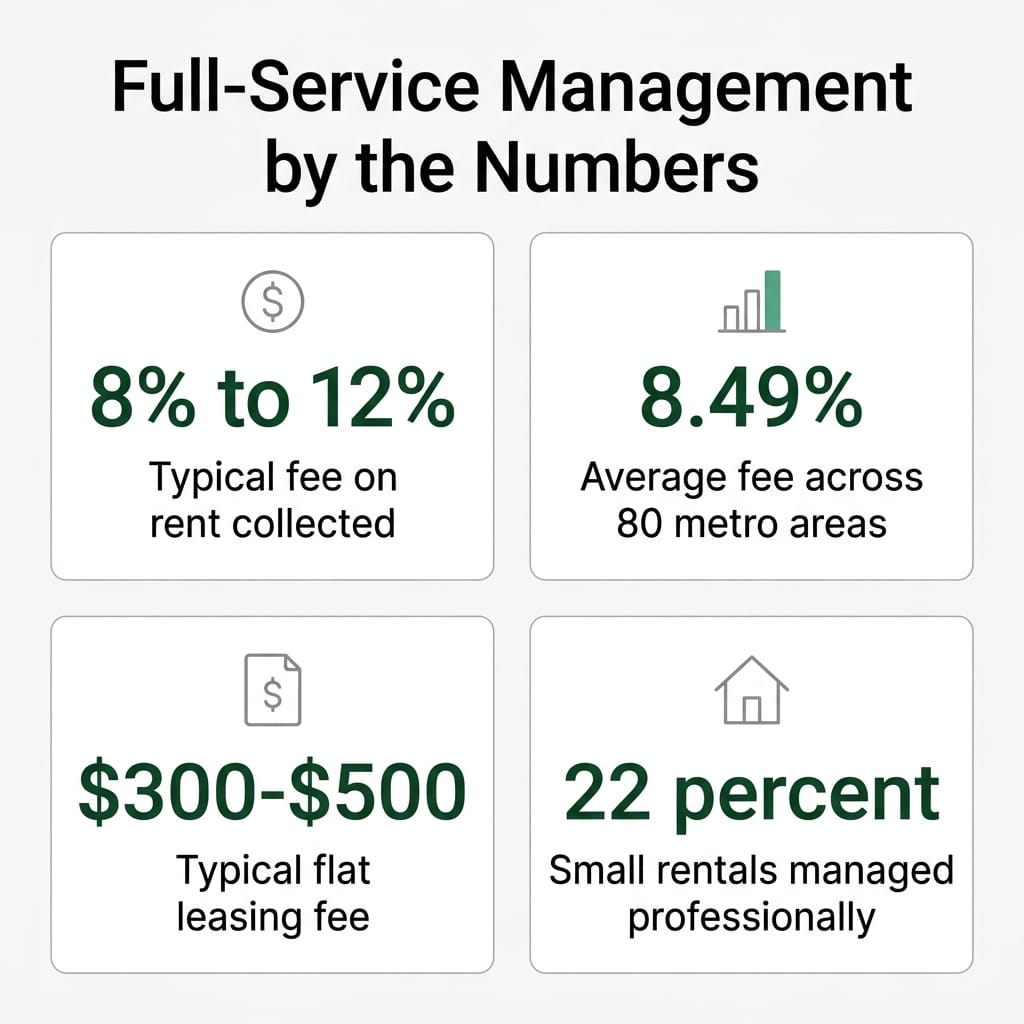
Full-service managers typically take 8% to 12% of the rent collected. Some charge a flat monthly fee instead. A survey of 80 metro areas, as of January 2026, put the average at 8.49% of monthly rent, with rates from 3.75% to 14.0%.
Then the extra fees show up. Leasing fees are often a flat $300 to $500. You may also budget for tenant placement fees, lease renewal fees, maintenance markups and eviction fees. They add up fast.
Plenty of small owners skip the manager. A 2021 federal survey found about 22% of small rentals, with 1 to 4 units, were professionally managed. For properties with 150 or more units, it was 84%.
Full-service manager | Self-managing | Software plus local help | |
|---|---|---|---|
Cost | A share of rent, typically 8% to 12%, plus leasing, renewal and repair markups | No management fee, but your tools and your hours | Plans from free to $86/mo (incl. $28 platform fee), with add-ons only when needed |
Who decides | The manager makes many routine calls under the contract | You | You. Hemlane does not decide for you |
Your time and after-hours load | Low | High. Every 2 AM call is yours | Lower. 24/7 emergency support starts on Essential |
Risk | Rests on the manager you pick and the contract you sign | Legal and process gaps fall on you | You still own compliance, with tools and local agents to keep the process tight |
What reaches you | Rent minus fees and markups | All the rent, minus whatever your payment tools charge | 100% of rent paid to you, $0 ACH fees, 100% of late fees, no repair markups |


We are a technology company, not a property management firm. We make no decisions for owners. Starter is free. Basic is $30/mo (incl. $28 platform fee). Essential is $48/mo (incl. $28 platform fee). Complete is $86/mo (incl. $28 platform fee). Repairs are invoiced with no markups. The number on the lease is the number that lands in your account. We save clients over $1.15 million per month compared to other solutions. See how local agents and one platform work together.
Hire full-service if:
- You want no part in day-to-day operations.
- You are fine with a manager making routine calls for you.
- Your numbers still work after the fee and the extras.
- The contract passes the checks below.
Check these terms before you sign:
- Is the fee based on rent due or rent collected? Paying on rent that never came in gets costly when a tenant falls behind.
- What is the leasing fee for each new tenant?
- Is there a renewal fee?
- Is there a markup on repairs?
- What eviction fees apply?
- How and when can you end the contract?
When should a landlord move from self-managing to software plus local help?
There is no magic number of doors. Add help when the work costs you more than the help would. Watch for these signs: you live far away, you are adding doors, emergencies hit after hours, you chase the same repairs, rent comes in late, or the rental eats your week. Match each sign to one fix, not a whole bundle.
If you run one rental on your own, you are in good company. A 2021 federal survey found about 86% of rental properties hold just one unit. About 70% are owned by individual investors.
Score yourself. Each sign you check points to one kind of help.
- You live far from the rental. From a distance, you can't judge a repair in person. Remote management leans on trustworthy tenants, clear communication, local contacts, legal compliance and automated payments. The fix is licensed local agents for showings, inspections and key handoffs, plus automated rent collection.
- Vacancy and weekend showings. The fix is the tenant placement and leasing services covered in the pricing section above.
- The 2 AM call. The fix is our Essential plan, which adds a dedicated repair coordinator and 24/7 emergency support. They pick up, troubleshoot and dispatch so you don't have to.
- Chasing the same repairs. The fix is Complete, which adds vetted repair network access, or the repair coordinator on Essential.
- Constant tenant messages. The fix is our Rental Assistant, which handles tenant communication with a 3-hour response time during business hours. You keep every decision.
- Late rent and eviction worry. The fix is our eviction services. There is a one-time pre-eviction service and an ongoing mediation service billed per unit each month. Across these services, 90% of cases are resolved through mediation. Mediation does not always work. Eviction is never quick or certain, and rules, timelines and costs change by state.
- The rental eats your week. Owners who pair our platform with local agents see 70% time savings.
Then climb only as far as you need:
- Self-manage with free tools. Starter is free and includes tenant screening, rental accounting and listing to major websites.
- Add rent collection and messaging. Basic, $30/mo (incl. $28 platform fee), adds lease tracking, document storage, rent collection and tenant messaging.
- Add repair coordination. Essential, $48/mo (incl. $28 platform fee), adds a dedicated repair coordinator, 24/7 emergency support and state-specific lease documents.
- Add an assistant. Complete, $86/mo (incl. $28 platform fee), adds a property management assistant, vetted repair network access and VIP support.
- Add services as needed. Tenant placement, inspections and eviction assistance are add-ons you buy when the moment calls for them.
Not every owner needs every tier. Many stop at step one or two for years. You can try a plan for 14 days first.
We support over 20k rental properties in 4,418 cities, in all 50 states. We have completed 61,218 service requests, and users rate us 5 stars. We hold 4.8-star user reviews on Capterra, GetApp and Software Advice.
Manage your rentals on Hemlane
Frequently Asked Questions
What is the 2% rule in rental property?
The 2% rule says a rental is worth a look if the monthly rent equals at least 2% of the purchase price. That takes very high rent for the price. Few properties clear that bar.
The rule only compares rent to price. It says nothing about condition, location, cap rate or what you net after expenses. Homes that pass it tend to be cheaper, and cheaper homes can cost more in repairs. Use it as a first filter, not a verdict.
What is the 50% rule in rental property?
The 50% rule estimates that operating expenses eat about half of gross rent. A rental bringing in $40,000 a year would spend about $20,000 on expenses, leaving about $20,000 in net operating income.
The mortgage is not part of that half. One common version also leaves out management fees and HOA dues. Real costs swing widely by location, property type and management costs. Once you own, swap the estimate for your real numbers. Our rental accounting tracks them with bank sync, a cash flow report and an income statement.
What is the 7% rule for rental property?
The 7% rule has no single standard meaning. Investors use it in different ways, so ask which version someone means.
One widely cited version says gross yearly rent should be at least 7% of the purchase price. On a $300,000 property, that is about $21,000 a year, or about $1,750 a month. Many investors read it as a yield test instead, treating 7% as a minimum cap rate or yield on cost. Put together, the 2% and 7% rules screen rent against price, and the 50% rule sketches costs. All three are quick screens. None replaces a full look at the numbers.
Keep the decisions. Hand off the load. Get started with Hemlane
Hemlane, Inc. is a technology company that helps you manage your long-term rental properties. Communications between you and Hemlane are protected by our Privacy Policy. Hemlane also provides access to independent licensed professionals and self-help services at your specific direction. We are not a property management firm. We cannot make any decisions on behalf of any property owners. Any content found in the Hemlane Academy is not a substitute for advice and ideas from a qualified legal source or expert. You are responsible for performing additional research to confirm you are complying with all laws applicable to your rental situation.
Sources


- U.S. Environmental Protection Agency — Real Estate Disclosures about Potential Lead Hazards | US EPA · retrieved November 3, 2026
- Federal Trade Commission — Using Consumer Reports: What Landlords Need to Know | Federal Trade Commission · retrieved October 26, 2026
- California Department of Justice, Office of the Attorney General — Limits on Rent Increases | State of California - Department of Justice - Office of the Attorney General · retrieved November 3, 2026
- Oregon Department of Administrative Services — Newsroom - Department of Administrative Services · retrieved November 3, 2026
- Consumer Financial Protection Bureau — CFPB Reports Highlight Problems with Tenant Background Checks | Consumer Financial Protection Bureau · retrieved November 3, 2026
- Cornell Law School Legal Information Institute (24 CFR 982.503) — 24 CFR § 982.503 - Payment standard areas, schedule, and amounts. | Electronic Code of Federal Regulations (e-CFR) | US Law | LII / Legal Information Institute · retrieved November 3, 2026
- iPropertyManagement — Average Property Management Fees (2026): by Type & by State · retrieved November 3, 2026
- iPropertyManagement — Property Management Fees: Average Monthly & One-Time Costs · retrieved November 3, 2026
- U.S. Department of Housing and Urban Development (HUD archives) — HUD Archives: HUD and Census Bureau Release Findings of 2021 Rental Housing Finance Survey · retrieved October 26, 2026
- Allstate — Home vs Landlord Insurance for Rental Property | Allstate · retrieved November 3, 2026
- LawDepot — 9 Tips for the Out-of-State Landlord - LawDepot.com · retrieved November 3, 2026
- RealWealth — 1 Rule in Real Estate Investing & 2 Rule Explained · retrieved November 3, 2026
- BiggerPockets — What Is the 2% Rule in Real Estate? Pros, Cons, & How to Use · retrieved November 3, 2026
- SmartAsset — What Is the 50% Rule in Real Estate? · retrieved November 3, 2026
- Zencore Homes — What Is the 7% Rule in Real Estate? | Zencore Homes · retrieved November 3, 2026
- Rod Khleif — Real Estate Rules of Thumb Explained (2026) · retrieved November 3, 2026
Get the Latest in Real Estate & Property Management!
I consent to receiving news, emails, and related marketing communications. I have read and agree with the privacy policy.


