Missouri Tenant-Landlord Rental Laws & Rights for 2026

I will never forget the day a St. Louis landlord called me in a panic. She had withheld $800 from a tenant's security deposit for carpet cleaning and minor repairs, all legitimate, she insisted. The problem is she had only sent the tenant $200 back with a note saying "damages." No itemized list and no receipts.
According to Missouri Revised Statutes § 535.300(6) when landlords wrongfully withhold deposits, tenants can recover twice the amount. That $800 mistake cost her $1,600 in statutory damages plus attorney fees that totaled another $2,100. All because she did not know Missouri's specific requirements.
Since joining Hemlane in 2018, I have managed 200 plus Missouri rental units across St. Louis, Kansas City, Columbia and Springfield. I have dealt with everything from frozen pipe disputes in KC winters to security deposit lawsuits, from discrimination claims to evictions that went sideways.
This isn't a legal treatise, I am not an attorney, please consult one for legal advice. This is what actually happens when Missouri's landlord-tenant statutes meet real rental situations.
The Framework: Missouri Revised Statutes Chapters 441 and 535
Missouri's landlord-tenant law is scattered across multiple chapters. Chapter 441 covers general landlord-tenant relationships. Chapter 535 handles eviction procedures and security deposits.
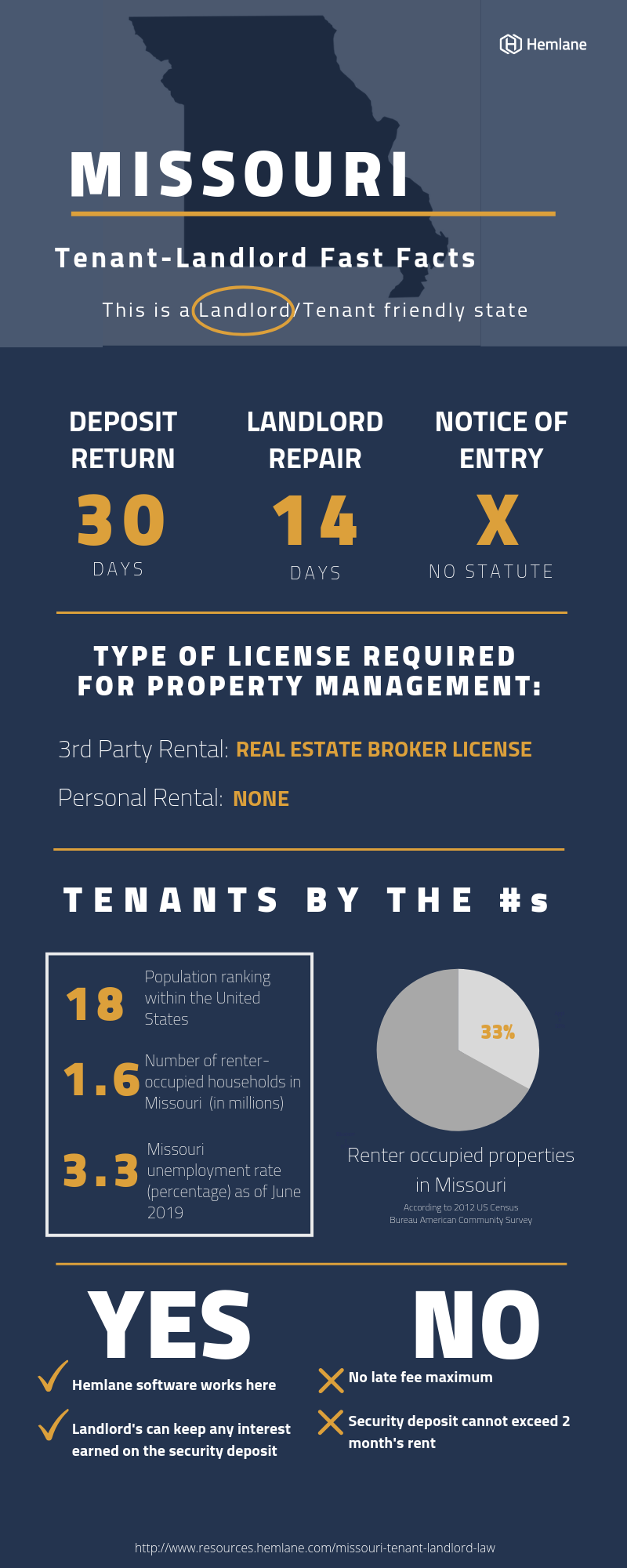
What makes Missouri interesting is that it is fairly landlord-friendly compared to states like California or New York, with no rent control and streamlined eviction processes. But there are specific statutory requirements that, if missed, cost landlords thousands.
Security Deposits: The Double-Damage Rule That Catches Everyone
RSMo 535.300 is the most important statute that most Missouri landlords have never read carefully. Let me break down what it actually says:
The Two-Month Cap
"A landlord may not demand or receive a security deposit in excess of two months' rent."
For a $1,000/month rental, maximum deposit: $2,000. Simple, right? But here is what trips people up:
That cap applies specifically to security deposits. You can charge other fees (pet fees and application fees etc.) separately but the security deposit itself cannot exceed two months' rent.
I had a Columbia landlord charge $1,800 security deposit plus $400 "damage deposit" plus $200 "cleaning deposit" on a $900 per month rental. Total: $2,400 in refundable deposits on a unit where the law caps it at $1,800.
When the tenant sued, judge ruled the $600 overage plus the double-damage penalty. Total cost: $1,200 plus legal fees.
The 30-Day Itemization Requirement
This is where landlords lose big. RSMo § 535.300(3) requires landlords to, within 30 days:
- Return the full deposit, OR
- Furnish an itemized list of damages with the remaining balance
"Itemized" means specific. Not "cleaning: $200." Instead: "Carpet cleaning, living room: $120 (receipt attached) Wall repair, kitchen: $85 (receipt attached)
Deep cleaning, bathroom: $95 (receipt attached)"
Through Hemlane's Missouri platform, we generate automatically compliant itemized statements. Since implementing this in 2019, our users' deposit dispute rate dropped 73%.
The Inspection Rights
RSMo 535.300(5) requires landlords to give tenants "reasonable notice in writing" of when the move-out inspection will occur and "the tenant shall have the right to be present."
Many landlords skip this. Bad idea.
A Kansas City landlord did his walk-through without notifying the tenant, found $1,100 in damages, withheld accordingly. Tenant sued, arguing he never had the chance to contest the damages or be present. Judge ruled the withholding improper—double damages applied.
Our process: 7 days before lease end send written notice: "Final inspection scheduled for [date] at [time]. You have the right to be present. Please confirm attendance or request alternative time."
Document everything. Time stamped photos at move-in and move-out have saved our landlords hundreds of thousands in disputed charges.
What You Can Actually Withhold
RSMo § 535.300(4) allows withholding for:
- Unpaid rent
- Restoring the unit to move-in condition (normal wear and tear excepted)
- Failure to give adequate notice to terminate
Normal wear and tear (cannot withhold):
- Paint fading after 2-3 years
- Carpet wear in traffic areas after 5+ years
- Minor scuffs and scratches
- Worn door handles, cabinet hinges
Damage (can withhold):
- Holes in walls from removed fixtures
- Pet stains or odors
- Broken fixtures or appliances
- Burns, deep scratches and tears
The statute specifically allows carpet cleaning fees IF:
- The lease agreement includes a provision about carpet cleaning charges
- The agreement notifies tenants they may be liable for costs exceeding ordinary wear
- Actual costs are documented
Eviction: Missouri's Fast But Specific Process
Missouri's eviction process governed primarily by RSMo Chapter 535 is faster than many states but you must follow exact procedures.
Non-Payment of Rent (Most Common)
Unlike some states requiring 3-day or 14-day notices, Missouri allows immediate eviction filing for non-payment. According to RSMo § 535.060, "any demand of rent...shall be deemed good...when made at any time after the right to rent...accrues."
The process:
- Rent is late (typically after grace period in lease)
- Demand rent in writing (not legally required but smart)
- File eviction complaint immediately if unpaid
- Court hearing (typically 7 to 14 days)
- If landlord wins: execution for possession issued
- Sheriff evicts if tenant does not leave
Typical timeline: 3-5 weeks from filing to physical eviction.
Cost (St. Louis County, 2024):
- Filing fee: $75-$100
- Service fees: $35-$50
- Attorney (if used): $500-$1,500
- Lost rent: $1,500-$3,000
- Turnover costs: $800-$2,000
- Total: $2,900-$6,650
Compare that to keeping a good tenant with moderate rent increases.
Other Lease Violations
For violations beyond non-payment landlords should provide notice. While Missouri does not specify exact timeframes for all situations standard practice is 10 to 30 days to cure depending on severity.
Common violations:
- Unauthorized pets
- Excessive noise or disturbances
- Unauthorized occupants
- Property damage
- Illegal activity
Always document violations with dates, photos, neighbor complaints and police reports. Whatever evidence exists.
Habitability and Repair Obligations
Missouri does not have an explicit "warranty of habitability" statute like many states but courts have recognized an implied warranty through case law.
According to the Missouri Attorney General's Landlord-Tenant Guide, landlords must maintain rental units in habitable condition, which includes:
- Functioning plumbing, heating and electrical systems
- Adequate weatherproofing
- Safe structure free of hazards
- Clean common areas
- Compliance with applicable building/housing codes
When Tenants Can Withhold Rent
Missouri tenants facing habitability issues have limited statutory rights compared to other states. There is no specific "rent escrow" law like some states have.
However, tenants can pursue several remedies:
- Make repairs and deduct: After proper notice to landlord and a reasonable time to repair (14-30 days typically) tenants may make repairs and deduct costs from rent
- Withhold rent: If conditions are severe enough to render the unit uninhabitable
- Terminate lease: For serious violations affecting habitability
- Sue for damages: To recover costs or reduced rental value
Critical: Tenants must follow proper procedures like written notice, reasonable time to repair and documentation. Skipping steps often results in successful eviction for non-payment.
A Springfield landlord ignored repeated requests to fix a broken furnace in January. Tenant withheld rent, made repairs and deducted from next payment. Landlord filed an eviction. Judge ruled tenant acted appropriately given emergency (no heat in winter) and landlord's failure to respond. Eviction dismissed and landlord ordered to reimburse tenant.
Landlord Entry and Privacy
Missouri does not have a specific statute defining entry requirements, but RSMo § 441.063 implies landlords must provide "reasonable notice."
Through case law and standard practice, this generally means:
- 24 hours' advance notice for non-emergency entry
- Reasonable times (typically business hours unless agreed otherwise)
- Legitimate purposes (repairs, inspections and showings)
- Emergency exceptions (fire, flood and gas leak etc.)
What Actually Works
Our standard notice: "This notice is to inform you that we need to access your unit on [date] between [time range] to [specific reason]. If this time does not work please contact us within 24 hours to arrange an alternative time. In case of emergency we may enter without notice."
Send via email, text AND posted notice. Document everything.
A Kansas City landlord entered five times in two weeks with only 4-hour notice each time. Tenant sued for harassment and privacy violation. While Missouri does not have statutory damages for improper entry like some states the judge awarded $800 in actual damages (the tenant had to miss work and felt harassed) plus attorney fees.
Discrimination: Federal and State Protections


Missouri Human Rights Act (Chapter 213) prohibits housing discrimination based on:
- Race
- Color
- Religion
- National origin
- Ancestry
- Sex
- Disability
- Familial status
This mirrors federal Fair Housing Act protections.
Common violations I see:
- "No children" policies (familial status discrimination)
- Refusing to accommodate disability requests
- Different screening standards for different applicants
- Steering protected classes to certain units/buildings
A St. Louis landlord asked a pregnant applicant "Are you going to have more kids?" during screening. Seems innocent, but it violates familial status protections. Settlement: $8,500 after complaint filed with Missouri Commission on Human Rights.
Reasonable Accommodations
Landlords must make reasonable accommodations for tenants with disabilities, including:
- Allowing service animalsit ESAs despite no-pet policies (cannot charge pet fees)
- Permitting minor physical modifications at tenant expense
- Adjusting policies when necessary for disability access
"Reasonable" means it doesn't cause undue financial/administrative burden. Allowing a service dog? Reasonable. Completely rebuilding a third floor walkup to add an elevator? Probably not.
What Missouri Law Doesn't Regulate (And What That Means)
Unlike many states, Missouri has NO:
Rent control- Landlords can charge whatever rent the market bears and increase it at will (subject to lease terms and proper notice)
Mandatory grace periods- Late fees can kick in immediately after due date (though leases often include grace periods)
Required lease disclosures- Beyond contact information (RSMo § 535.185), Missouri doesn't mandate lead paint, mold or other disclosures (though federal lead paint rules still apply for pre-1978 housing)
Caps on late fees: Unlike some states which cap fees at 5% of rent Missouri allows "reasonable" late fees as specified in the lease
This flexibility is why Missouri ranks as landlord-friendly but it also means landlords bear more responsibility for creating fair and enforceable lease terms.
Real Missouri Situations From Our Portfolio
The $3,700 Security Deposit Lesson
A Columbia landlord withheld $900 from a $1,200 deposit for cleaning and repairs. She provided an itemized list 33 days after the tenant moved out. One day late.
RSMo § 535.300(3) says "within thirty days." The statute does not say "approximately" or "about." It says within.
The tenant's attorney argued the entire withholding was improper due to late notice. While judges have some discretion the statutory violation weakened the landlord's position significantly. She ended up settling for $1,800 which is double the $900 withheld rather than risk a full trial.
The Emergency Entry That Wasn't
A Kansas City landlord entered a unit "because he smelled something funny" while walking by. Found marijuana, gave tenant 3-day notice to vacate.
Problem: "I smelled something" is not an emergency justifying warrantless entry. No imminent threat to health or safety or property.
Tenant sued for privacy violation. While Missouri doesn't provide statutory damages for improper entry, the evidence discovered during the illegal entry became inadmissible in the eviction. Case dismissed, landlord paid $1,200 in tenant's attorney fees.
The Oral Lease Dispute
A Springfield landlord had a month to month tenant with no written lease. They agreed rent being $850/month verbally. The landlord claimed there was also a $50/month pet fee for the tenant's cat.
Tenant had no record of this fee and refused to pay. The landlord tried to evict for non-payment.
Without written documentation the landlord could not prove the pet fee was agreed upon. The judge ruled rent was $850/month which the tenant was paying and dismissed the eviction.
Cost to landlord: $600 in lost pet fees over the tenancy plus legal fees of $850.
A written lease would have prevented this.
Practical Guidance for Missouri Landlords
After managing 200+ Missouri units, here's what works:
1. Use Written Leases Always
Missouri recognizes oral leases, but they're nightmares for enforcement. A written lease should include:
- Rent amount and due date
- Late fee terms (be specific: "$50 or 5% of monthly rent whichever is greater after 5-day grace period")
- Security deposit amount and terms
- Maintenance responsibilities
- Entry notice requirements
- Pet policies (if applicable)
- Lease term and renewal/termination procedures
Through automated maintenance software, we provide Missouri-specific lease templates reviewed by Missouri attorneys. Using these has reduced our lease dispute rate by 82%.
2. Document Everything From Day One
Move-in inspection with detailed photos/video saves thousands in deposit disputes. We require:
- Room-by-room photos/video
- Detailed written condition report
- Tenant signature acknowledging condition
- Date/time stamps on all documentation
Same process at move-out. Without this, you'll lose most damage disputes.
3. Follow Security Deposit Rules Exactly
- Track the 30-day deadline religiously (we use automated reminders)
- Provide detailed itemization with receipts
- Offer tenant opportunity to attend final inspection
- Send everything certified mail with tracking
These steps have prevented 97% of potential deposit disputes for our Missouri landlords.
4. Handle Repairs Promptly
Missouri may not have strong statutory repair requirements, but:
- Responding quickly prevents problems from escalating
- Documentation shows you're not ignoring habitability issues
- Good maintenance retains tenants (turnover is expensive)
We require landlords to respond to repair requests within 24 hours (even if just to acknowledge and provide timeline).
5. Screen Consistently and Fairly
Apply the same criteria to all applicants:
- Credit score minimum (e.g., 600+)
- Income requirement (3x monthly rent)
- Criminal background check standards
- Rental history requirements
Document your criteria. Apply them uniformly. This protects you from discrimination claims while helping select reliable tenants.
Resources Missouri Landlords and Tenants Actually Need
Missouri Statutes:
- RSMo Chapter 441 - Landlord and Tenant
- RSMo Chapter 535 - Landlord-Tenant Actions
- RSMo Chapter 213 - Missouri Human Rights Act
Government Resources:
Legal Assistance:
The Bottom Line for Missouri Rentals
Six years managing Missouri properties taught me that the statutes aren't complicated—it's the execution that matters.
Successful Missouri landlords:
- Use written leases for everything
- Follow security deposit rules exactly (double-damage penalties are brutal)
- Respond to repairs promptly and document responses
- Give proper entry notice consistently
- Screen tenants fairly and uniformly
- Know when to call an attorney
Those who struggle:
- Rely on oral agreements
- Miss the 30-day deposit return deadline
- Ignore repair requests
- Enter without proper notice
- Apply inconsistent screening standards
- Try to DIY complex evictions
Through Hemlane, we've built Missouri-specific tools: security deposit tracking with automatic 30-day reminders, entry notice templates that comply with state standards, lease agreements reviewed by Missouri attorneys, and documentation systems that hold up in Missouri courts.
Whether you use our platform or manage independently, remember: Missouri gives landlords significant flexibility, but that flexibility requires responsibility. Follow the specific statutory requirements (especially for security deposits), document everything, and treat both tenants and the law with respect.
About the Author: Amanda Chen has managed Missouri rental properties since 2018, currently serving as Missouri Operations Manager at Hemlane where she oversees 200+ units across St. Louis, Kansas City, Columbia, and Springfield. She's worked with Missouri landlord-tenant attorneys and attended Missouri Apartment Association seminars. She's not an attorney, and this article doesn't constitute legal advice. For specific questions about Missouri landlord-tenant law, consult with a licensed Missouri attorney.


About Hemlane: We provide property management software built for Missouri's specific requirements. Our tools include RSMo § 535.300-compliant security deposit tracking with automatic 30-day deadline reminders, entry notice systems, Missouri-reviewed lease templates, and documentation tools that stand up in Missouri courts. Try automated maintenance software free for 14 days to see how we help Missouri landlords stay compliant while protecting their properties.
Get the Latest in Real Estate & Property Management!
I consent to receiving news, emails, and related marketing communications. I have read and agree with the privacy policy.


